


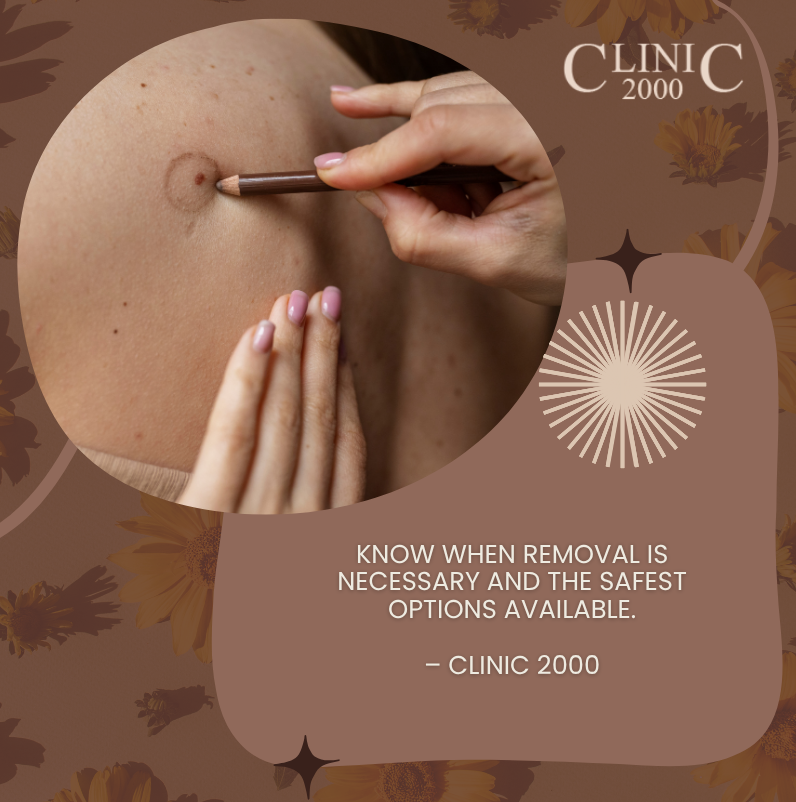
You have probably had a skin growth at some point in your life. A small lump on the neck, a dark spot you never noticed before, a rough patch on the hand that simply will not go away. Most of the time, these growths are harmless. But they can be unsightly, uncomfortable, or, in some cases, a sign of something that deserves medical attention.
The challenge is knowing which growths to leave alone, which to monitor, and which to have removed professionally. Self-treatment with home remedies or over-the-counter products can leave permanent scarring, cause infection, or miss a potentially serious diagnosis.
This guide explains the difference between the most common benign skin growths, when removal is advisable, and what the safest and most effective removal options look like at a professional medical clinic.
Understanding the Different Types of Skin Growths
Warts
Warts are caused by the human papillomavirus (HPV) and are contagious. They can appear anywhere on the body but are most common on the hands, feet, face, and genital area. Common warts typically have a rough, cauliflower-like surface. Plantar warts grow on the soles of the feet and can cause discomfort when walking. Flat warts appear in clusters on the face or arms.
Warts do not disappear permanently without treatment. While some may regress over time, particularly in children, they can spread to other parts of the body or to other people through direct contact.
Moles
Moles (melanocytic nevi) are clusters of pigmented cells that appear as dark, round, or oval spots on the skin. Most people have between 10 and 40 moles, and the majority are completely benign. However, moles should be monitored for changes in size, shape, colour, or texture, particularly if they become asymmetrical, develop irregular borders, vary in colour, grow larger than 6mm, or change over time.
The ABCDE rule (Asymmetry, Border, Colour, Diameter, Evolution) is a standard screening tool for identifying moles that may require further investigation. Any mole that shows two or more of these warning signs should be evaluated by a dermatologist promptly.
Skin Tags
Skin tags are small, soft, flesh-coloured growths that typically appear in areas where skin rubs against skin, such as the neck, armpits, groin, and eyelids. They are entirely benign and cause no health issues, but they can catch on clothing or jewellery and become irritated. Many people choose to have them removed for comfort or cosmetic reasons.
Sebaceous Cysts
Sebaceous cysts are benign, non-contagious lumps beneath the skin that form from blocked sebaceous (oil) glands. They are soft, movable, and slow-growing. While most are harmless, they can become inflamed or infected and may require drainage or surgical removal.
When Should You Remove a Skin Growth?
Not every growth needs to be removed, but professional removal is advisable in the following situations:
• The growth is changing in size, shape, or colour, which warrants diagnostic evaluation
• The growth bleeds, itches, or causes discomfort
• The growth is in a location prone to irritation such as the collar line, underarm, or eyelid
• You have a mole with suspicious features that should be sent for histopathology
• The growth is cosmetically bothersome and affecting your confidence
• You have recurrent or spreading warts that have not responded to topical treatments
Importantly, self-removal of warts or moles using scissors, razor blades, or chemical agents purchased online is strongly discouraged. This risks incomplete removal (which causes recurrence), serious scarring, infection, and, in the case of moles, missing an early diagnosis that could be clinically significant.
Professional Removal Methods at Clinic 2000
Radiofrequency Ablation (RFA)
Radiofrequency ablation is the most commonly used method at Clinic 2000 for warts, skin tags, and benign moles. A fine probe delivers controlled radiofrequency energy to the target tissue, precisely removing the growth while cauterizing the blood vessels simultaneously. This technique results in minimal bleeding, excellent precision, and a very low risk of scarring when performed correctly. The treated site heals within five to seven days.
Laser Removal
Laser removal uses a focused beam of light to vaporize the pigmented or abnormal tissue. It is particularly effective for flat moles, pigmented spots, and difficult-to-reach warts. The E+ Laser at Clinic 2000 is FDA and CE approved and allows for precise depth control, minimizing damage to surrounding tissue.
Surgical Excision
For larger moles, cysts, or growths where a tissue sample is required for histopathological examination, surgical excision is the appropriate approach. The growth is removed under local anaesthesia with a scalpel, and the tissue is sent to a pathology lab for analysis. Sutures are placed and removed after seven to ten days. This method is essential whenever there is any concern about the nature of a growth.
What to Expect: Before, During, and After
Before
Your dermatologist will examine the growth thoroughly before recommending a removal method. For any mole with suspicious features, dermoscopy (a magnified examination of the pigment pattern) may be performed. Photographs are taken for baseline documentation.
During
A topical numbing cream is applied 20 to 30 minutes before the procedure. Radiofrequency and laser procedures are quick, typically five to fifteen minutes per growth. You will feel minimal discomfort throughout.
After
A small scab forms over the treated area within 24 hours, which is a normal part of healing. You will be advised to keep the area dry, avoid sun exposure, and apply the prescribed topical antibiotic. The scab typically falls off within seven to ten days, leaving smooth skin underneath.
Why Clinic 2000 for Skin Growth Removal in Hyderabad?
At Clinic 2000, all removal procedures are performed under the supervision of Dr. Ravindranath Reddy, a medical cosmetologist with 35 years of clinical experience. We use only FDA and CE-approved technology, and for any mole removal where there is clinical uncertainty, histopathological testing is performed as standard practice.
Our approach is diagnostic first. We do not simply remove a growth because a patient requests it. We assess it, classify it, and recommend the right method to ensure the safest outcome with minimal scarring and zero diagnostic risk.
Conclusion
Warts, moles, and skin tags are common, and most are completely harmless. But when they change, become uncomfortable, or simply make you self-conscious, professional removal is the safest and most effective solution.
At Clinic 2000, our expert team offers precise, scar-minimising removal procedures that ensure both your cosmetic and clinical needs are met. If you have a skin growth you would like assessed or removed, book a consultation with us today in Hyderabad.
Frequently Asked Questions
Q: Can I remove a mole or wart at home?
Home removal is not recommended. It risks scarring, infection, incomplete removal, and in the case of moles, missing an early melanoma diagnosis. Professional removal is safe, quick, and highly effective.
Q: Will removal leave a scar?
When performed correctly using radiofrequency or laser, scarring is minimal and often barely visible. Surgical excision leaves a fine linear scar, but our team uses precise techniques to minimize this.
Q: How many sessions are needed to remove a wart?
Most warts require one to two radiofrequency or laser sessions. Larger or deeper warts may require an additional session.
Q: Is mole removal painful?
Topical numbing cream is applied before the procedure. Most patients experience only minimal discomfort during the removal itself.
Q: Should I get histopathology done for every mole?
For moles with any suspicious features, irregular borders, colour variation, or rapid growth, histopathology is strongly recommended. At Clinic 2000, we advise this whenever there is any clinical uncertainty.