


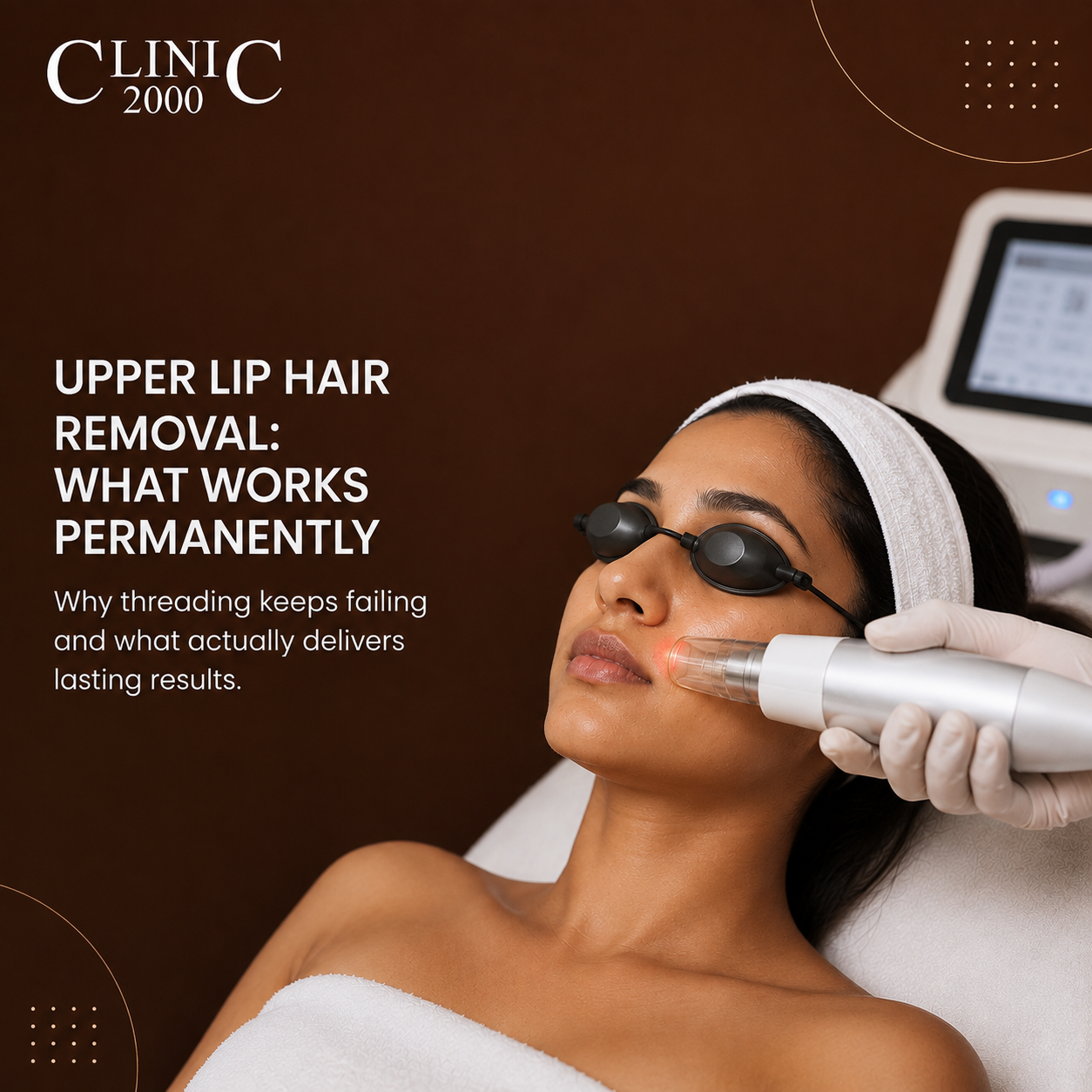
Every two weeks, the same routine. You notice the shadow above your lip in daylight, book a threading appointment, sit through the sting, and walk out smooth. Ten days later it is back, and often it looks slightly darker than before.
Upper lip hair is one of the most common cosmetic concerns women in India seek help for, and also one of the most poorly understood. Most people treat the visible hair without ever asking why it grows there so persistently in the first place.
This blog explains what actually drives upper lip hair growth, why temporary removal methods trap you in a cycle, when facial hair is signalling a hormonal issue, and what permanent reduction realistically looks like, including the laser upper lip hair removal options available at Clinic 2000 in Hyderabad.
Why Upper Lip Hair Is So Persistent
The follicles on the upper lip are androgen-sensitive. That means they respond directly to male hormones, which every woman produces in small amounts. When androgen levels rise even slightly, or when the follicles become more sensitive to normal levels, fine vellus hair converts into thicker, darker terminal hair.
This is why upper lip hair often appears or worsens at specific life stages:
• Puberty, when hormone levels shift dramatically for the first time
• PCOS onset, which raises circulating androgens
• Pregnancy and the postpartum period
• Perimenopause and menopause, when oestrogen falls and the androgen ratio rises
• After starting or stopping hormonal contraception
Genetics also play a major role. South Asian, Middle Eastern and Mediterranean skin types have naturally denser facial follicle distribution. If your mother or sister has noticeable upper lip hair, you are far more likely to as well.
The Hidden Cost of Threading and Waxing
Threading and waxing work by pulling hair out from the root. The follicle survives completely intact, so it simply produces a new hair. The average regrowth cycle is 10 to 21 days, which means most women repeat the process 20 to 30 times a year for decades.
The repeated trauma has consequences that build slowly:
Post-Inflammatory Hyperpigmentation
Every threading or waxing session causes microscopic inflammation. On Indian skin, inflammation triggers melanin production. Over years, this creates a permanent darkened shadow above the lip that is often mistaken for hair when the area is actually already smooth. This is one of the most common reasons patients come to us convinced their hair has become “darker” when it is the skin that has changed. Understanding the difference between melasma and general pigmentation helps here, because upper lip darkening can be either.
Ingrown Hairs and Folliculitis
Hair pulled at an angle can regrow into the follicle wall instead of out through the skin. This produces small red bumps, occasional pustules, and further pigmentation once they heal.
Skin Laxity Around the Mouth
Decades of repeated pulling on delicate perioral skin contributes to early laxity in an area that is already prone to fine lines.
The Myth That Threading Makes Hair Thicker
Hair does not have memory. Removing it does not instruct the follicle to grow back stronger. What actually happens is that hair regrowing after root removal emerges with a blunt, tapered-off tip rather than the fine natural tip it had originally, which makes it feel coarser and look more visible against the skin.
What genuinely does change hair thickness over time is hormonal drive, not the removal method. If your upper lip hair is truly getting denser year on year, that is worth investigating medically rather than blaming your threading salon.
How Laser Upper Lip Hair Removal Actually Works
Laser hair removal uses a specific wavelength of light absorbed by melanin inside the hair shaft. That light energy converts to heat, travels down the shaft, and damages the follicle’s growth structures at the root, reducing its ability to produce new hair.
The critical detail is timing. A follicle can only be effectively treated when it is in the anagen, or active growth, phase. At any given moment only a portion of your upper lip follicles are in anagen. This is precisely why a single session cannot deliver permanent results, and why any clinic promising one-session permanence is misleading you.
Multiple sessions spaced correctly catch different follicles in their active phase until the majority have been treated. You can read a fuller technical explanation in our guide to whether laser hair removal is truly permanent.
How Many Sessions Will You Need?
For the upper lip specifically, most patients require 6 to 8 sessions spaced 4 to 6 weeks apart. Facial hair cycles faster than body hair, which is why the interval is shorter than for legs or arms.
Expected progression:
• Sessions 1 to 2: noticeably slower regrowth, finer texture
• Sessions 3 to 5: visible density reduction, longer gaps between regrowth
• Sessions 6 to 8: majority reduction, remaining hair fine and light
• Maintenance: one session every 8 to 12 months for most patients, more often if a hormonal driver is active
Patients with PCOS or other hormonal conditions typically need more sessions and more frequent maintenance, because the underlying hormonal signal continues stimulating follicles regardless of treatment. This is a medical reality, not a treatment failure, and it is why we assess hormonal history before starting.
Is Laser Safe on the Upper Lip for Indian Skin?
Yes, when the correct device and settings are used. This is the single most important safety question, because Indian skin types carry more epidermal melanin, and the wrong laser can target skin pigment instead of hair pigment, causing burns or pigmentation.
Devices with longer wavelengths and integrated cooling are appropriate for Fitzpatrick type IV and V skin, which covers most Indian patients. At Clinic 2000, our laser hair removal programme uses FDA and CE approved E+ technology with settings calibrated to each patient’s skin type after an in-person assessment and, where indicated, a patch test.
The upper lip also sits close to the nostrils and mouth, so eye shielding, correct handpiece angle and operator skill matter considerably more than they do on a large flat area like the legs.
When Upper Lip Hair Is Signalling Something Deeper
Facial hair in women that is coarse, rapidly increasing, or accompanied by other symptoms deserves medical evaluation rather than only cosmetic treatment. Warning signs include:
• Hair appearing on the chin, jawline, chest or abdomen as well
• Irregular or absent periods
• Unexplained weight gain, particularly around the abdomen
• Scalp hair thinning at the crown alongside increased facial hair
• Acne that appeared or worsened in adulthood
This combination often points toward PCOS. Treating the hair alone in this situation means treating a symptom while the cause continues. Our detailed guide on PCOS and weight gain covers the hormonal mechanism in full.
What Upper Lip Laser Hair Removal Costs in Hyderabad
Pricing varies by clinic based on the device used, the operator’s qualification, and whether sessions are sold individually or as a package. The upper lip is one of the smallest treatment areas, which makes it one of the most affordable places to start.
A word of caution on price. Extremely low per-session pricing usually indicates an older diode-only device, an unqualified operator, or underpowered settings that will not produce meaningful reduction. Paying less per session for treatment that requires twice as many sessions is not a saving. Our transparent laser hair removal cost breakdown explains what determines pricing across body areas.
How Clinic 2000 Approaches Upper Lip Hair Removal
We begin every upper lip consultation with two questions most clinics skip: what is your hormonal history, and has this area already been pigmented by years of threading?
The answers change the plan. A patient with hormonal drive needs a longer session series and a medical workup. A patient with established post-inflammatory pigmentation needs that treated alongside or before laser, otherwise she will finish her sessions hair-free and still see a shadow. In those cases we may combine laser with a pigmentation treatment protocol for a genuinely clear result.
Every plan is reviewed by Dr. Ravindranath Reddy, whose 28 years of clinical practice across skin, hair and metabolic health means facial hair is assessed as a whole-body signal, not just a surface concern.
Conclusion
Upper lip hair is not a grooming failure. It is a follicle responding to hormones and genetics, and no amount of threading will change that instruction. Temporary methods manage the symptom every two weeks. Laser reduces the follicle’s ability to produce hair at all.
If you have been threading the same patch of skin for a decade and want to know what permanent reduction would actually take in your case, book an assessment with our team at Clinic 2000, Hyderabad.
| Permanent upper lip hair removal – quick, safe, and effective. Call or walk in to Clinic 2000, Himayatnagar, Hyderabad. 📞 Call: +91 91000 67718 💬 WhatsApp: +91 96762 31891 🌐 clinic-2000.com |
Frequently Asked Questions
Q: Can upper lip hair be removed permanently?
Laser produces permanent hair reduction, which is the medically accurate term. Most patients achieve 70 to 90 percent lasting reduction after a full session series, with the remaining hair significantly finer and lighter. Occasional maintenance sessions keep results stable, particularly if a hormonal driver is present.
Q: Does laser on the upper lip hurt?
Most patients describe it as a warm snapping sensation lasting a fraction of a second per pulse. The upper lip is more sensitive than body areas, but the treatment window is very short, usually under two minutes. Topical numbing cream can be applied for patients with low pain thresholds.
Q: Will laser darken my upper lip skin?
Correctly performed laser should not cause darkening. Temporary redness for a few hours is normal. Pigmentation risk rises with incorrect settings, sun exposure immediately after treatment, or treating recently tanned skin, which is why we assess skin type and recent sun history before every session.
Q: Can I do laser if I have PCOS?
Yes, and many of our patients do. You should expect to need more sessions and more regular maintenance, because androgens continue stimulating the follicles. We recommend addressing the hormonal condition alongside the cosmetic treatment for the best long-term outcome.
Q: How long before my session should I stop threading?
Stop threading, waxing and plucking at least four weeks before your first session, because the laser needs an intact hair root to target. You may shave or trim during this period, as shaving leaves the root undisturbed.