


Your face is changing. Not dramatically, not all at once, but in small, persistent ways. The jawline that once looked sharp has softened. There is a subtle heaviness around the cheeks. The neck feels slightly looser. These are the early signs of skin laxity, and they happen to everyone as collagen production naturally slows with age.
In the past, the only way to address significant skin sagging was surgery: a facelift, with all the risks, recovery time, and expense that comes with it. Today, that is no longer the only option. HIFU, or High-Intensity Focused Ultrasound, is a clinically proven, non-surgical treatment that lifts and tightens skin from the inside out, without incisions, without anaesthesia, and without significant downtime.
This guide explains exactly how HIFU works, what it treats, what results you can realistically expect, and why the quality of the machine and the expertise of the clinic matters enormously.
What Is HIFU?
HIFU stands for High-Intensity Focused Ultrasound. It is a technology that uses focused ultrasound energy to penetrate deep beneath the skin surface and generate precise heat at targeted tissue layers. This heat stimulates the body’s natural collagen and elastin production, causing the skin to gradually lift, firm, and tighten over the weeks following treatment.
The key reason HIFU works so effectively is the depth it targets. Standard skincare treatments, peels, and even many laser treatments work on the epidermal (surface) or superficial dermal layers. HIFU, by contrast, reaches the SMAS layer, the Superficial Muscular Aponeurotic System. This is the same tissue layer that surgeons tighten during a traditional facelift. HIFU achieves this effect non-invasively, through focused ultrasound energy rather than surgical incision.
What Does HIFU Treat?
HIFU is most commonly used on the face and neck, but it is also increasingly used for body tightening. The most frequently treated areas include:
• Sagging cheeks and midface laxity
• Jowls and lower face heaviness
• Neck skin looseness and bands
• Brow drooping and forehead laxity
• Double chin and submental fat
• Fine lines and early wrinkles
• Body skin laxity (abdomen, arms, thighs)
It is particularly effective for patients in their late thirties to fifties who are experiencing early to moderate skin laxity and want a preventive or corrective approach without committing to surgery. Patients with more advanced sagging may benefit from a combination of HIFU with other treatments for optimal results.
How the HIFU Procedure Works
Consultation and Assessment
Before any treatment, our dermatologist at Clinic 2000 conducts a detailed skin assessment to determine the degree of laxity, the depth of treatment required, and whether HIFU is the most appropriate option for your skin type and concern. Not every patient is an ideal HIFU candidate, and an honest evaluation is essential.
The Treatment Session
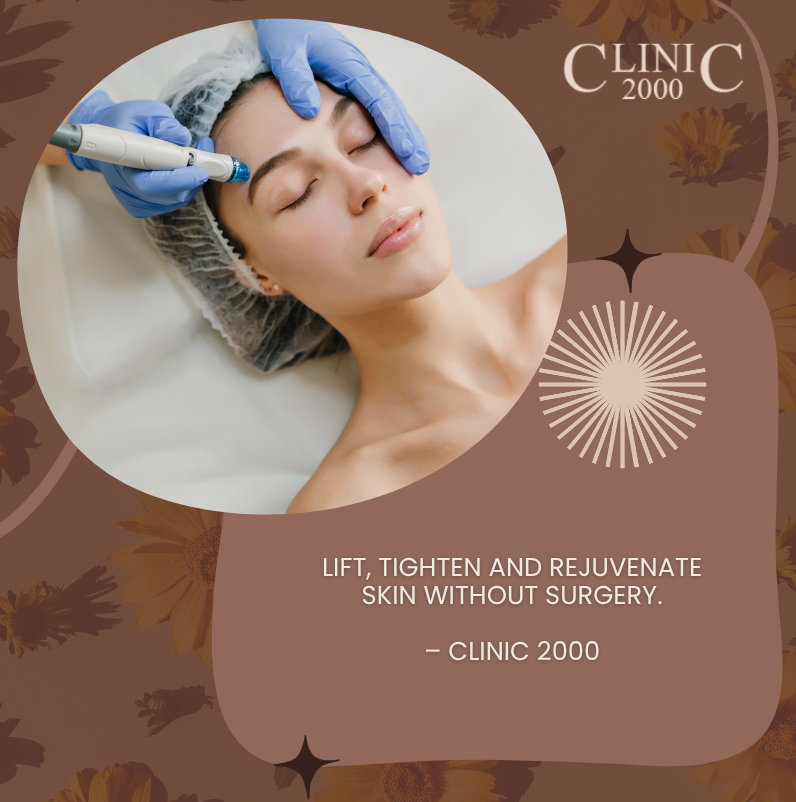
A gel is applied to the treatment area to facilitate the transmission of ultrasound energy. The HIFU handpiece is then moved across the skin in precise passes. Most patients feel a warm, tingling sensation during treatment as the energy penetrates deep tissue. There may be occasional brief moments of deeper heat, which are normal and indicate the energy is reaching the target layer.
A full face and neck treatment typically takes 60 to 90 minutes. Smaller areas such as the brow or chin take 20 to 30 minutes. No numbing cream is required in most cases, though topical anaesthetic can be applied for sensitive patients.
After the Treatment
There is minimal to no downtime after HIFU. Most patients return to their normal activities immediately. Some experience mild redness, slight swelling, or tenderness in the treated area for 24 to 48 hours. These are normal responses and resolve on their own.
When Will You See Results?
HIFU results develop gradually over time. This is because the treatment works by stimulating collagen production, a biological process that takes weeks to complete. Here is a general timeline:
• Weeks 1 to 4: Initial lifting effect visible; skin appears firmer and more refreshed
• Months 2 to 3: Collagen remodelling accelerates; more noticeable tightening
• Months 3 to 6: Peak results visible; skin is significantly lifted and firmer
• 12 to 18 months: Results can last with a healthy skincare routine
One of the most appealing aspects of HIFU is that results continue to improve over several months, unlike injectable treatments that produce immediate but temporary effects.
How Many HIFU Sessions Are Needed?
Most patients see significant improvement after a single HIFU session. Depending on the degree of laxity and the desired outcome, some patients benefit from two sessions spaced six months apart. Maintenance sessions are typically recommended every 12 to 18 months to sustain the lifting effect as the natural ageing process continues.
HIFU vs. Other Skin Tightening Options
HIFU vs. Botox and Fillers
Botox relaxes muscles to reduce wrinkles; fillers add volume to hollow areas. Neither addresses skin laxity directly. HIFU lifts tissue and stimulates collagen, providing a structural improvement that Botox and fillers cannot replicate. Many patients use all three modalities together for a comprehensive rejuvenation approach.
HIFU vs. Radiofrequency (RF) Treatments
RF treatments heat the dermis and can tighten skin, but they do not reach the SMAS layer. HIFU penetrates deeper and tends to produce more significant lifting. RF is often better suited for surface-level tightening and texture improvement, while HIFU addresses deeper structural laxity.
HIFU vs. Surgical Facelift
A surgical facelift produces the most dramatic results for advanced sagging. However, it carries surgical risks, requires anaesthesia, involves significant downtime (2 to 4 weeks), and is considerably more expensive. HIFU is ideal for patients who are not yet ready for, or do not require, surgery, offering a natural-looking improvement with far less risk and recovery.
HIFU at Clinic 2000
At Clinic 2000, we use a US FDA and CE-cleared HIFU device, one of the most advanced systems available in Hyderabad. Our treatments are performed by trained medical professionals under the supervision of Dr. Ravindranath Reddy, a Medical Cosmetologist with over 35 years of clinical experience.
Before recommending HIFU, our team conducts a thorough assessment to ensure it is the right treatment for your specific concern and skin condition. We customize the depth of energy delivery, the number of passes, and the intensity settings based on your individual needs, not a one-size-fits-all protocol.
Clinic 2000 has helped hundreds of patients in Hyderabad achieve visible, natural-looking skin lifting without the risks and recovery associated with surgery.
Tips for Maintaining Your HIFU Results
• Use a broad-spectrum SPF 30 or higher daily, UV exposure accelerates collagen breakdown
• Stay well-hydrated and maintain a balanced, protein-rich diet to support collagen synthesis
• Avoid smoking, which significantly accelerates skin ageing and collagen loss
• Follow the personalised skincare routine recommended by your dermatologist post-treatment
• Schedule maintenance sessions every 12 to 18 months to sustain your results
Conclusion
HIFU represents a genuine breakthrough in non-surgical skin rejuvenation. For patients experiencing early to moderate skin laxity, it offers a safe, clinically proven method to lift and tighten without surgery. The results are natural, progressive, and long-lasting.
At Clinic 2000, our team has the expertise and technology to deliver HIFU treatments that produce real, visible improvement. If you are considering a non-surgical facelift or skin tightening treatment in Hyderabad, book a consultation with us today. We will assess your skin honestly and recommend the approach that will genuinely make a difference for you.
Frequently Asked Questions
Q: Is HIFU painful?
Most patients describe the sensation as warm tingling with occasional brief moments of deeper heat. It is generally well-tolerated. Topical numbing cream can be applied for sensitive patients if needed.
Q: Is there any downtime after HIFU?
HIFU requires minimal to no downtime. Some redness or mild swelling may occur for 24 to 48 hours, but most patients return to normal activities the same day.
Q: How long do HIFU results last?
Results typically last 12 to 18 months depending on the patient’s age, skin condition, and lifestyle. Maintenance sessions are recommended annually.
Q: Is HIFU safe for Indian skin tones?
Yes. HIFU targets deep tissue layers and does not affect skin pigmentation, making it safe and effective for all skin types and Indian skin tones.
Q: What is the cost of HIFU treatment in Hyderabad?
HIFU cost varies depending on the area treated and the number of passes required. At Clinic 2000, we provide a personalized quote after your initial consultation. Contact us at +91-96762-31891 for pricing details.