


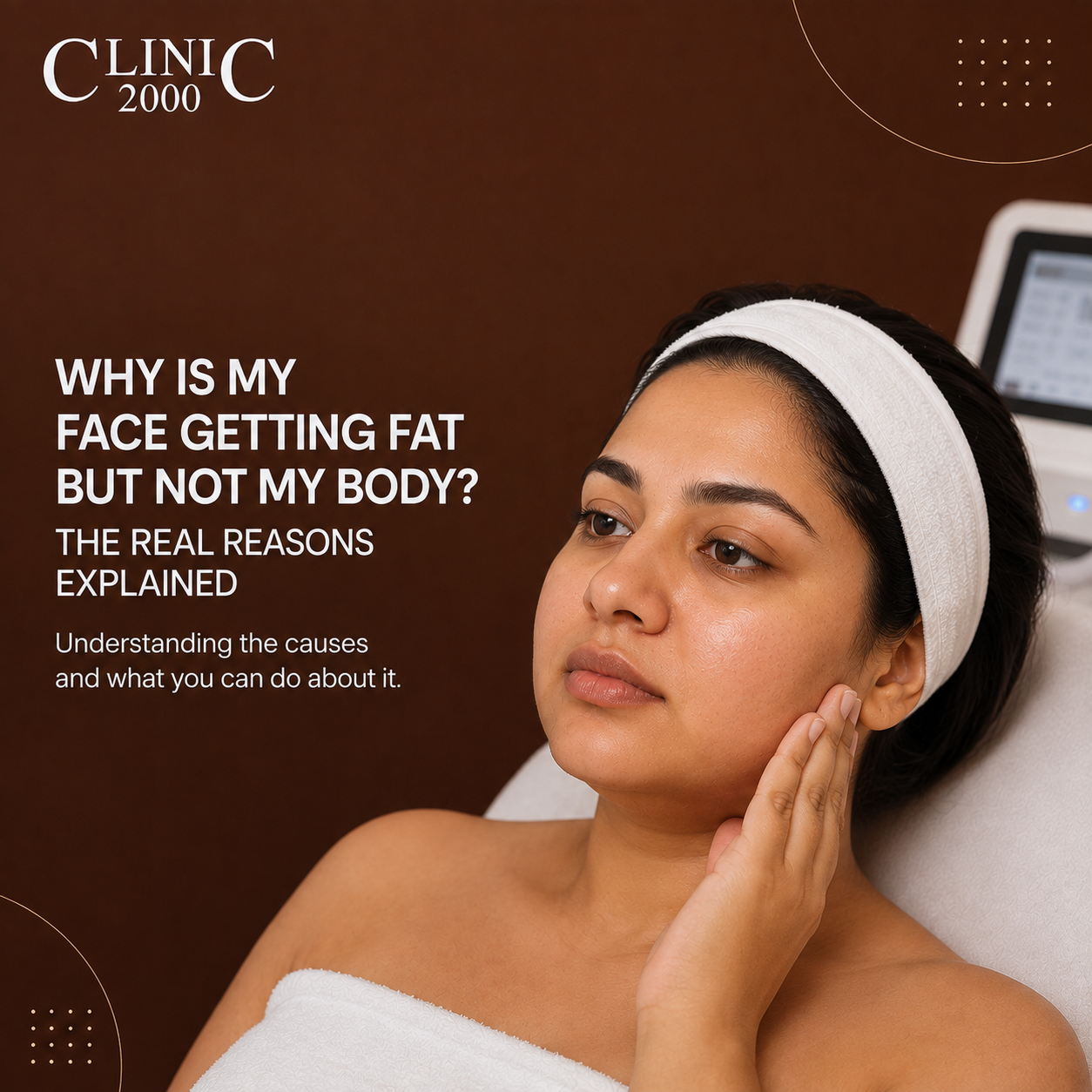
Your clothes fit the same. The scale has barely moved. But when you look at photographs from a year ago, your face is unmistakably fuller, rounder through the cheeks, heavier under the jaw.
This is one of the most common and most distressing patterns people describe to us, and it is almost always met online with the same useless advice: do face exercises, chew gum, drink water. None of that addresses why the face changed while the body did not.
This blog explains the seven genuine causes of facial fullness, how to distinguish fat accumulation from fluid retention within 48 hours, when facial changes are a medical signal rather than a cosmetic one, and what actually produces change.
First, the Distinction That Changes Everything
Facial fullness comes from two entirely different sources, and they respond to completely different interventions.
Facial Fat
Adipose tissue in the buccal, malar and submental compartments of the face. It accumulates slowly over months, stays consistent throughout the day, and responds only to overall body fat reduction.
Facial Fluid
Water retained in the interstitial tissue. It fluctuates within hours, is markedly worse on waking, and responds to sodium, sleep, alcohol and hormonal factors.
Most people describing sudden facial fullness are experiencing fluid, not fat. Fat does not appear overnight. If your face looked normal last week and puffy this week, you are almost certainly looking at fluid.
The 48-Hour Self-Check
Before assuming you have gained facial fat, run this simple observation over two days.
• Photograph your face in the same light within ten minutes of waking
• Photograph again at 8 pm the same day
• Repeat both on day two
If the evening photo is noticeably slimmer than the morning photo, you are dealing with fluid retention. Fat does not redistribute over twelve hours. If both photos look identical across both days, and the change has developed over months, you are looking at fat accumulation.
Seven Reasons Your Face Changes While Your Body Doesn’t
1. Sodium and Fluid Retention
The face has loose connective tissue and abundant lymphatic drainage, which makes it the first place fluid becomes visible. A single high-sodium meal, common with restaurant food, packaged snacks and Indian pickles and papads, can produce visible morning puffiness. The body holds the fluid; the face displays it.
2. Chronic Stress and Cortisol
Sustained cortisol elevation drives fat toward central and facial compartments specifically, while sparing the limbs. This is why a period of intense work stress can leave someone with a rounder face and unchanged arms and legs. Cortisol also promotes sodium retention, compounding the effect.
3. Sleep Debt
Poor sleep impairs lymphatic clearance and raises cortisol simultaneously. Under six hours consistently produces visible periorbital and cheek puffiness, often accompanied by darker under-eye shadowing. Our guide to the real causes of dark circles covers how sleep and fluid interact in that specific area.
4. Alcohol
Alcohol is both dehydrating and inflammatory. The dehydration triggers compensatory fluid retention, and the inflammatory response causes vasodilation and tissue swelling. Facial puffiness after drinking typically peaks 12 to 24 hours later, not immediately.
5. Hormonal and Metabolic Conditions
Several conditions produce facial fullness disproportionate to body weight:
• Hypothyroidism, which causes a characteristic non-pitting facial puffiness alongside fatigue and cold intolerance
• PCOS, which drives androgen-influenced fat distribution and is often accompanied by facial hair and irregular cycles
• Cushing’s syndrome, a rarer condition producing a distinctly rounded face alongside central weight gain and skin changes
• Kidney or cardiac issues, which cause fluid retention presenting first around the eyes
If facial fullness is accompanied by fatigue, cycle irregularity, unexplained weight change or skin changes, this warrants medical evaluation rather than cosmetic treatment. Our detailed guide on PCOS and weight gain explains one of the most common of these in full.
6. Medications
Corticosteroids are the most frequent culprit and can produce dramatic facial rounding within weeks. Certain antidepressants, antihypertensives, insulin and hormonal treatments also contribute. Never stop a prescribed medication because of facial changes; discuss it with your prescribing doctor.
7. Genetics and Fat Distribution
Some people simply store fat facially first. Buccal fat pad size is largely inherited and determines how full the mid-face looks at any given body weight. This is why two people at identical body fat percentages can have visibly different facial fullness, and it is also why some faces change dramatically with small weight fluctuations.
Why Face Exercises and Spot Reduction Do Not Work
Spot reduction is not physiologically possible anywhere on the body, including the face. Fat is mobilised systemically through hormonal signalling, not locally through muscle contraction near the fat.
Facial exercises strengthen the underlying muscles of facial expression. They do not reduce the fat layer sitting above those muscles. In some cases, hypertrophy of the masseter muscle from excessive chewing, including gum chewing marketed as a jawline exercise, actually widens the lower face rather than slimming it.
What genuinely reduces facial fat is reducing overall body fat. The face is often among the first areas to show that reduction, which is why patients frequently notice facial change before their clothes fit differently.
The Flip Side: Losing Fat Too Fast
Rapid fat loss produces the opposite problem. Aggressive calorie restriction or rapid pharmacological weight loss can strip facial fat faster than skin can retract, producing hollowed cheeks and a gaunt appearance. This has become widely discussed as a side effect of GLP-1 medications, and we cover it in detail in our guide to Mounjaro face and post-weight-loss facial changes.
The goal is not the fastest possible loss. It is a rate the face and skin can adapt to.
What Actually Produces Change
• Reduce sodium load, particularly evening intake, and increase potassium through fruit and vegetables
• Prioritise seven to eight hours of sleep, which addresses both lymphatic clearance and cortisol
• Reduce alcohol frequency rather than just quantity per occasion
• Rule out thyroid dysfunction and PCOS with basic blood work if fullness is persistent
• Address overall body fat through a medically structured plan rather than crash dieting
• Manage chronic stress, which is not soft advice but a direct intervention on cortisol-driven fat distribution
For patients whose facial fullness is genuinely fat rather than fluid, our medically supervised weight loss programme addresses the systemic driver rather than chasing the symptom. Where skin laxity remains after fat reduction, non-surgical skin tightening can restore definition along the jawline.
How Clinic 2000 Approaches Facial Fullness
We start by determining whether we are looking at fat, fluid, or a medical cause, because treating the wrong one wastes months. That assessment includes body composition analysis, a review of medications and sleep, and where indicated, thyroid and hormonal blood work.
If it is fluid, we address the drivers. If it is a metabolic or hormonal condition, we treat that condition. If it is genuine fat accumulation, we build a structured fat loss plan through our obesity and weight management services, because facial fat responds to systemic change and nothing else.
As South India’s first dedicated bariatric and obesity treatment centre, our approach under Dr. Ravindranath Reddy treats facial change as a metabolic signal rather than an isolated cosmetic complaint. That distinction is why patients often arrive asking about their face and leave with a thyroid diagnosis they did not know they had.
Conclusion
A face that changes while the body stays the same is telling you something. Usually it is fluid, stress or sleep. Sometimes it is a thyroid or hormonal condition that has gone undetected. Occasionally it is genuine fat accumulation that the face simply displays first.
What it is almost never is a problem that face exercises will fix. If your facial fullness has persisted for months, or arrived alongside fatigue, cycle changes or weight gain, book an assessment with our team at Clinic 2000, Hyderabad and find out which of the seven causes is actually yours.
Face looking fuller even though your body hasn’t changed? Find out why.
Book a facial fullness & weight management consultation at Clinic 2000, Hyderabad.
📞 Call: +91 91000 67718 | 💬 WhatsApp: +91 96762 31891 | 📍 Himayatnagar, Hyderabad | 🌐 clinic-2000.com
Frequently Asked Questions
Q: Why is my face fat but not my body?
Most commonly this is fluid retention rather than fat, driven by sodium, sleep debt, stress or alcohol. It can also reflect a hormonal condition such as hypothyroidism or PCOS, or simply a genetic tendency to store fat facially first. A morning-versus-evening photo comparison over two days usually distinguishes fluid from fat.
Q: Can I reduce face fat without losing body weight?
Not meaningfully. Spot reduction is not physiologically possible. Facial fat responds to overall body fat reduction. What you can change independently is fluid retention, through sodium, sleep, alcohol and stress management.
Q: Do face exercises reduce facial fat?
No. Facial exercises work the muscles beneath the fat layer, not the fat itself. Excessive chewing can actually enlarge the masseter muscle and widen the lower face.
Q: How quickly does facial puffiness from salt go away?
Usually within 24 to 48 hours once sodium intake normalises and hydration is adequate. Puffiness that persists beyond several days consistently is unlikely to be dietary sodium alone and warrants evaluation.
Q: When should I see a doctor about facial fullness?
If it developed rapidly without weight gain, or is accompanied by fatigue, cold intolerance, irregular periods, unexplained weight change, or swelling elsewhere in the body. These combinations point toward thyroid, hormonal, kidney or cardiac causes that need investigation.