


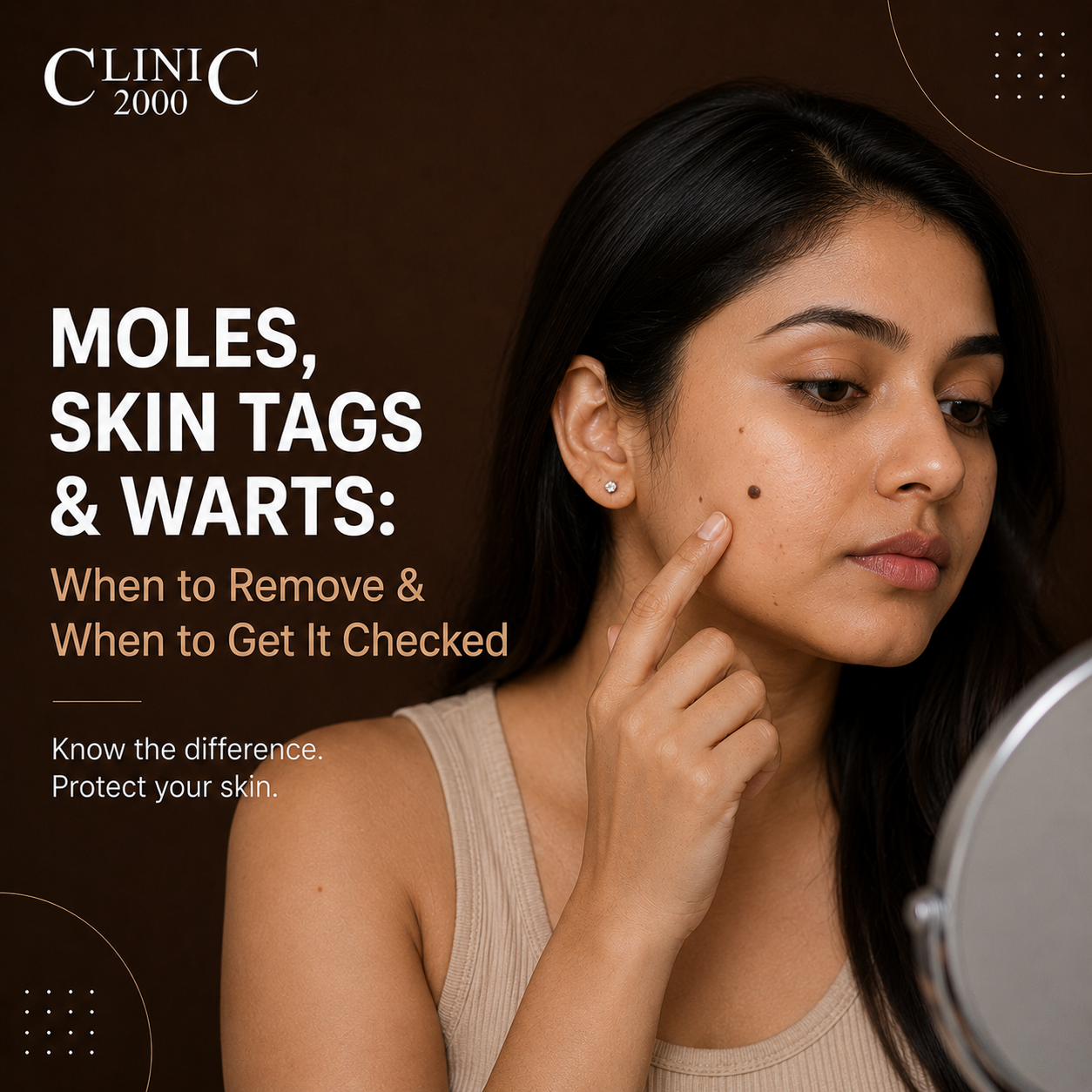
Most people ignore a mole for years and then decide, quite suddenly, that it needs to go. Usually it is a photograph, a wedding, or a new outfit that prompts it.
That is a reasonable enough motivation. What is not reasonable, and what we see the consequences of regularly, is what happens next: a home removal kit ordered online, a thread tied around a skin tag, or a cauterisation pen bought from a marketplace.
This blog explains how to tell moles, tags and warts apart, the warning signs that mean a lesion needs medical assessment rather than cosmetic removal, why home removal carries risks well beyond scarring, and what safe mole removal actually involves.
Telling Them Apart
Moles (Nevi)
Clusters of pigment-producing melanocytes. Usually brown or black, flat or slightly raised, round or oval with a defined border. Most appear in childhood and adolescence. The average adult has 10 to 40. They are not contagious and do not spread.
Skin Tags (Acrochordons)
Soft, flesh-coloured growths attached by a narrow stalk. Common in areas of friction: neck, underarms, under the breasts, groin, eyelids. They are entirely benign.
Clinically, multiple skin tags are worth noting. Their appearance correlates with insulin resistance and metabolic syndrome, particularly when accompanied by acanthosis nigricans, the velvety darkening seen at the neck and underarms. Patients presenting with numerous tags often benefit from metabolic screening through our obesity and metabolic services.
Warts (Verrucae)
Caused by human papillomavirus infection of the epidermis. Rough, raised, often with a cauliflower-like surface and characteristic small black dots, which are thrombosed capillaries rather than “roots” or “seeds”.
Warts are contagious, spread by direct contact and by self-inoculation through scratching or shaving. This is the key practical difference from moles and tags.
The ABCDE Rule: When a Mole Needs Medical Attention
This is the most important section of this article. Any mole showing these features requires evaluation before any cosmetic decision is made.
• A for Asymmetry: one half does not match the other
• B for Border: edges that are irregular, notched, blurred or poorly defined
• C for Colour: multiple shades within one lesion, or an unusual colour such as red, white or blue
• D for Diameter: larger than 6 mm, roughly a pencil eraser
• E for Evolving: any change in size, shape, colour, or elevation over weeks to months
Additional warning signs warranting prompt assessment:
• Bleeding without any injury
• Itching, tenderness or persistent irritation
• A sore that does not heal within three to four weeks
• A new mole appearing after the age of 35
• A mole that looks clearly different from all your others
These signs do not mean a lesion is malignant. Most are not. They mean the lesion needs to be examined by a doctor rather than removed by a beautician.
Why Home Removal Is Genuinely Dangerous
Three separate categories of risk, and the third is the one almost nobody considers.
Scarring and Infection
Chemical removal kits contain caustic agents with no depth control. They damage surrounding healthy tissue unpredictably, frequently producing a scar considerably more noticeable than the original lesion. Thread-tying a skin tag causes necrosis without any sterile field, and infection in that context is common.
Incomplete Removal
Superficial destruction leaves the deeper portion intact. Moles recur, often with irregular pigmentation that makes future assessment harder. Warts recur because the viral infection was never eliminated.
The Missed Diagnosis
This is the serious one. If a lesion is destroyed at home, there is no tissue left to examine. A suspicious lesion that should have gone to histopathology is simply gone, along with the opportunity to identify it. Delayed diagnosis of skin cancer is the single strongest argument against home removal, and it applies regardless of how benign a lesion appears to the untrained eye.
Clinical Removal Methods
Radiofrequency Ablation
High-frequency energy vaporises the lesion with precise depth control and simultaneous coagulation, minimising bleeding. Excellent for raised moles, skin tags and warts. Fast, performed under local anaesthesia, and generally produces good cosmetic outcomes.
Laser Ablation
Precise vaporisation with minimal thermal spread to surrounding tissue. Well suited to smaller lesions and cosmetically sensitive areas such as the face.
Surgical Excision
The lesion is cut out and closed with sutures. This is the method of choice for any lesion requiring histopathological examination, and for deeper moles where complete removal matters more than avoiding a linear scar.
Cryotherapy
Liquid nitrogen freezing, primarily used for warts. Usually requires several sessions and can cause temporary or occasionally persistent hypopigmentation, which is a meaningful consideration on Indian skin.
The method is selected by the lesion, not by clinic preference. A flat pigmented mole with any atypical feature should be excised for examination, not ablated.
Will It Scar?
Some mark is possible with any removal method. What determines the outcome:
• Lesion size and depth, with deeper lesions requiring more tissue disruption
• Location, as the chest, shoulders and jawline are more prone to hypertrophic scarring
• Individual healing tendency, particularly a personal or family history of keloids
• Method appropriateness for that specific lesion
• Aftercare compliance, especially sun protection
On Indian skin, temporary post-inflammatory hyperpigmentation at the site is common and usually resolves over two to six months with sun protection. Patients with a keloid history must disclose it before any procedure, as it changes both the method and the aftercare protocol. Our guidance on how different scar types behave explains why healing tendency varies so much between individuals.
Do Warts Come Back?
Frequently, and it is important to understand why. Removing a wart eliminates the visible lesion but not necessarily the HPV infection in the surrounding skin. Recurrence rates are meaningful across all treatment methods.
Reducing recurrence involves:
• Treating all lesions rather than only the visible ones that bother you
• Avoiding scratching or shaving over warts, which spreads virus to new sites
• Keeping the area dry, as moisture supports viral persistence
• Not sharing towels, razors or footwear
Patients who are immunosuppressed or diabetic experience higher recurrence and warrant closer follow-up.
How Clinic 2000 Approaches Removal
Every lesion is examined before any removal is discussed. We assess morphology, history and change, and where any feature raises concern, we recommend excision with histopathology rather than cosmetic ablation. That recommendation sometimes disappoints patients who wanted a quick five-minute procedure, and we make it anyway.
Where the lesion is clearly benign, we select the method that suits its size, depth and location, performed under local anaesthesia with sterile technique through our skin treatment services. Multiple lesions are usually addressed in a single session.
We also look at the wider picture. A patient presenting with fifteen new skin tags in two years is showing us a metabolic signal, not just a cosmetic one, and that conversation happens because Dr. Ravindranath Reddy practises across both dermatological and metabolic medicine.
Not every mole, skin tag, or wart needs to be removed—but some changes shouldn’t be ignored.
Learn when these common skin growths can be treated cosmetically and when they need a professional skin evaluation at Clinic 2000, Himayatnagar, Hyderabad.
📞 Call: +91 91000 67718 | 💬 WhatsApp: +91 96762 31891 | 📍 Himayatnagar, Hyderabad | 🌐 clinic-2000.com
Conclusion
A mole that has not changed in twenty years and a mole that changed last month are entirely different clinical situations, even if they look similar. The ABCDE rule takes thirty seconds and is the most useful skin knowledge most people never acquire.
Whatever you decide about removal, do not do it at home. The scarring risk is real, the recurrence risk is high, and the diagnostic risk is unacceptable. Book an assessment with our team at Clinic 2000, Hyderabad and have it looked at properly first.
Frequently Asked Questions
Q: Is mole removal safe?
Yes, when performed clinically after proper examination. The lesion should be assessed before removal, and any mole with atypical features should be excised and sent for histopathology rather than ablated. Home removal is unsafe and eliminates the possibility of diagnosis.
Q: How do I know if a mole is dangerous?
Use the ABCDE rule: asymmetry, irregular border, multiple colours, diameter over 6 mm, and any evolution in size, shape or colour. Bleeding without injury, persistent itching, or a new mole appearing after 35 also warrant assessment.
Q: Will mole removal leave a scar?
Some mark is possible with any method. Small superficial lesions removed by radiofrequency or laser usually heal with minimal marking. Deeper lesions and surgical excision leave a small linear scar. On Indian skin, temporary darkening at the site is common and typically fades over two to six months.
Q: Can skin tags be removed at home?
They should not be. Thread-tying and over-the-counter kits cause uncontrolled tissue death without a sterile field, with real infection and scarring risk. Clinical removal takes minutes and heals predictably.
Q: Why do my warts keep coming back?
Because removal eliminates the visible lesion but not always the underlying HPV infection in surrounding skin. Treating all lesions rather than only the visible ones, avoiding scratching and shaving over them, and keeping the area dry all reduce recurrence.