


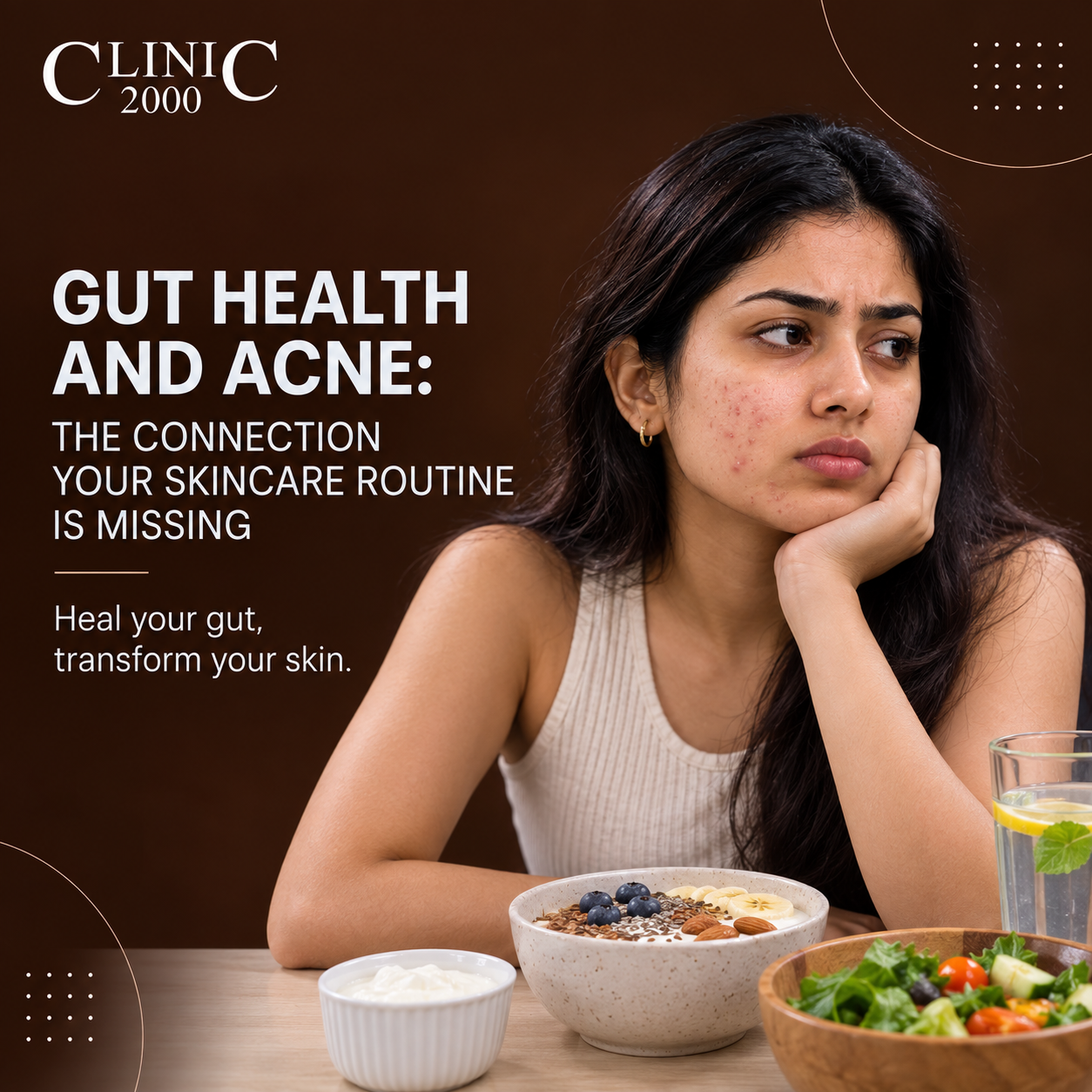
You have a twelve-step routine. You have tried salicylic acid, niacinamide, benzoyl peroxide and three different cleansers. Your skin is still breaking out, and it is breaking out in the same places it always has.
At some point in that process, most people encounter the claim that acne starts in the gut. Like most viral health claims, it is part true, part overstated, and almost entirely stripped of the nuance that makes it useful.
This blog separates what the evidence actually supports from what the wellness industry has invented, explains the mechanism connecting digestion to skin, and sets out where diet fits alongside clinical acne treatment.
What the Gut-Skin Axis Actually Is
The gut-skin axis describes a genuine bidirectional relationship between the gastrointestinal tract and the skin, mediated by three main channels.
Systemic Inflammation
The gut lining is a selective barrier. When barrier function is impaired, bacterial components such as lipopolysaccharide can enter circulation in greater quantity, driving low-grade systemic inflammation. Because acne is fundamentally an inflammatory condition, a higher baseline inflammatory state lowers the threshold at which a follicle becomes an inflamed lesion.
Hormonal and Metabolic Signalling
This is the strongest and best-documented pathway. Diet influences insulin and insulin-like growth factor 1, or IGF-1. Elevated IGF-1 increases sebum production and stimulates the proliferation of cells lining the follicle, two of the four core drivers of acne. This is the mechanism connecting sugar and dairy to breakouts, and it is a hormonal pathway, not a mystical one.
Microbial Metabolites
Gut bacteria produce short-chain fatty acids during fibre fermentation. These metabolites have documented immunomodulatory effects, influencing how vigorously the immune system responds to inflammation elsewhere in the body, including the skin.
The Dietary Triggers With Real Evidence
Four dietary factors have meaningful research support. Everything else in this category is currently speculation.
1. High Glycaemic Load
The strongest evidence in the entire diet-acne literature. Foods that spike blood glucose rapidly raise insulin and IGF-1, which drives sebum production and follicular cell proliferation. In practical Indian dietary terms, this means white rice in large portions, refined wheat, sweetened beverages, bakery items and most packaged snacks.
The intervention is not elimination but modification: smaller rice portions, more whole grains and millets, protein and fibre alongside carbohydrate rather than carbohydrate alone, and reduced sweetened drinks.
2. Dairy, Particularly Skim Milk and Whey
Multiple observational studies associate milk intake with acne, with the association strongest for skim milk. The proposed mechanism is dairy’s effect on IGF-1 rather than its fat content, which is why skim milk shows a stronger association than full-fat.
Notably, fermented dairy such as curd and yoghurt shows a weaker association, and in some studies none at all. Whey protein supplements are the most consistently implicated dairy product, and any patient with sudden-onset adult acne who has recently started whey should consider that connection.
3. Chronically Low Fibre Intake
Low fibre reduces short-chain fatty acid production and shifts microbial composition. It also worsens glycaemic response to meals. The typical urban Indian diet has become progressively lower in fibre as millets and whole pulses have been replaced by refined grains.
4. Alcohol
Alcohol impairs gut barrier function, disrupts sleep architecture and raises inflammatory markers. Its effect on skin is indirect but real.
What About Probiotics?
Probiotic supplementation for acne is an area of genuine but preliminary research. Some small trials show modest improvement, particularly with certain Lactobacillus and Bifidobacterium strains, but the evidence base is not yet strong enough to recommend probiotics as a primary acne treatment.
What is more reliably useful is dietary fibre and fermented food intake, which supports microbial diversity more consistently than any single supplement strain. Curd, buttermilk, idli and dosa batter, and fermented pickles are all traditional components of South Indian diets that serve this function.
Be sceptical of expensive probiotic products marketed specifically for skin. The strain matters, the dose matters, and most consumer products disclose neither adequately.
Why Detoxes and Elimination Diets Backfire
Aggressive elimination protocols are among the most counterproductive things acne patients do.
• Severe restriction is a physiological stressor, raising cortisol, which independently worsens acne
• Eliminating entire food groups reduces microbial diversity, the opposite of the intended effect
• The rebound period after restriction typically involves higher glycaemic intake than baseline
• Restriction patterns can develop into disordered eating, a genuine risk we take seriously in clinical practice
There is also no physiological basis for “detoxing” the skin. The liver and kidneys clear metabolic waste; the skin is not an excretory organ for toxins, and juice cleanses do not accelerate anything.
Antibiotics, the Microbiome and Relapse
Oral antibiotics remain a legitimate and effective tool for moderate to severe inflammatory acne. They also reduce gut microbial diversity, and that effect can persist for months after the course ends.
This creates a clinical tension worth naming honestly: the treatment that clears the acne may transiently disturb the system some patients are simultaneously trying to support. The resolution is not to avoid antibiotics when they are indicated, but to use them for defined periods rather than open-endedly, and to support microbial recovery through diet during and after the course.
The pattern we watch for is relapse after antibiotic withdrawal, which is common and is one reason antibiotics alone are rarely an adequate long-term strategy.
The Clinical Reality: Diet Alone Rarely Clears Acne
This is the part the wellness internet leaves out. Dietary modification produces meaningful improvement in a subset of patients, particularly those with high glycaemic intake or significant dairy consumption. It rarely clears moderate to severe acne on its own.
Acne has four drivers: sebum, follicular blockage, bacteria and inflammation. Diet influences the first and last. It does not unblock a follicle that is already comedonal, and it does not resolve established inflammatory lesions.
A patient who spends eight months on elimination diets while nodular acne scars their cheeks has lost time that cannot be recovered, because scarring is permanent while acne is not. If you are unsure whether what you have is active acne or residual marks, our guide to telling acne apart from pigmentation will help, and our breakdown of the five acne scar types explains what happens when inflammatory acne is left untreated.
Where Metabolic Health Fits In
Insulin resistance connects gut health, diet and acne into a single picture. Patients with insulin resistance have chronically elevated insulin and IGF-1, which drives both sebum production and the metabolic pattern that leads to weight gain.
This is particularly relevant in PCOS, where insulin resistance, androgen excess and acne frequently occur together. Treating the acne topically while the underlying insulin resistance continues is a partial solution at best. Our detailed guide on PCOS and weight gain covers this hormonal-metabolic overlap, and where indicated we assess it through our obesity and metabolic services.
How Clinic 2000 Approaches Diet and Acne
We take the dietary conversation seriously without allowing it to delay treatment. In a first consultation we ask about glycaemic load, dairy and whey intake, fibre, alcohol and sleep, because these genuinely influence outcomes and because patients rarely volunteer them.
Where a patient shows signs of insulin resistance or PCOS, we investigate metabolically rather than treating skin in isolation. This is a specific advantage of a practice that treats both skin and metabolic health under one roof rather than in separate silos.
Simultaneously, we treat the acne clinically, because the follicles need addressing regardless of diet. Treatment is delivered through our skin treatment services under the supervision of Dr. Ravindranath Reddy, whose practice spans both dermatological and metabolic medicine.
Conclusion
The gut-skin connection is real, and the mechanism runs primarily through insulin and IGF-1 rather than anything mystical about detoxification. Reducing glycaemic load, moderating dairy and whey, and eating more fibre will help some patients meaningfully.
What it will not do is replace clinical treatment for moderate or severe acne, and pursuing it exclusively for months risks permanent scarring in exchange for a partial solution. Treat both. If your acne has resisted months of skincare and dietary effort, book an assessment with our team at Clinic 2000, Hyderabad.
Your skin and gut may be more connected than you think.
Explore the gut-skin connection and get a clinically guided approach to acne at Clinic 2000, Himayatnagar, Hyderabad.
📞 Call: +91 91000 67718 | 💬 WhatsApp: +91 96762 31891 | 📍 Himayatnagar, Hyderabad | 🌐 clinic-2000.com
Frequently Asked Questions
Q: Can gut health really cause acne?
Gut health influences acne primarily through systemic inflammation and through diet’s effect on insulin and IGF-1, which drive sebum production. It is a genuine contributing factor rather than a root cause, and it rarely explains acne on its own.
Q: Does dairy cause acne?
Observational evidence associates milk intake with acne, with the strongest association for skim milk and whey protein supplements. Fermented dairy such as curd shows a weaker association. If you have adult-onset acne and recently started whey protein, that connection is worth testing by stopping for eight weeks.
Q: Will cutting sugar clear my acne?
Reducing glycaemic load produces measurable improvement in many patients, and it is the best-supported dietary intervention available. It typically improves acne rather than clearing it, particularly in moderate to severe cases.
Q: Do probiotics help acne?
Preliminary research is promising but not yet strong enough to recommend probiotics as a primary treatment. Dietary fibre and fermented foods support microbial diversity more reliably than most commercial supplements.
Q: How long should I try dietary changes before seeking treatment?
If you have inflammatory or nodular acne, seek treatment now and adjust diet alongside it. Scarring forms during active inflammation and is permanent, so delaying clinical treatment for months of dietary trial carries a real cost.