


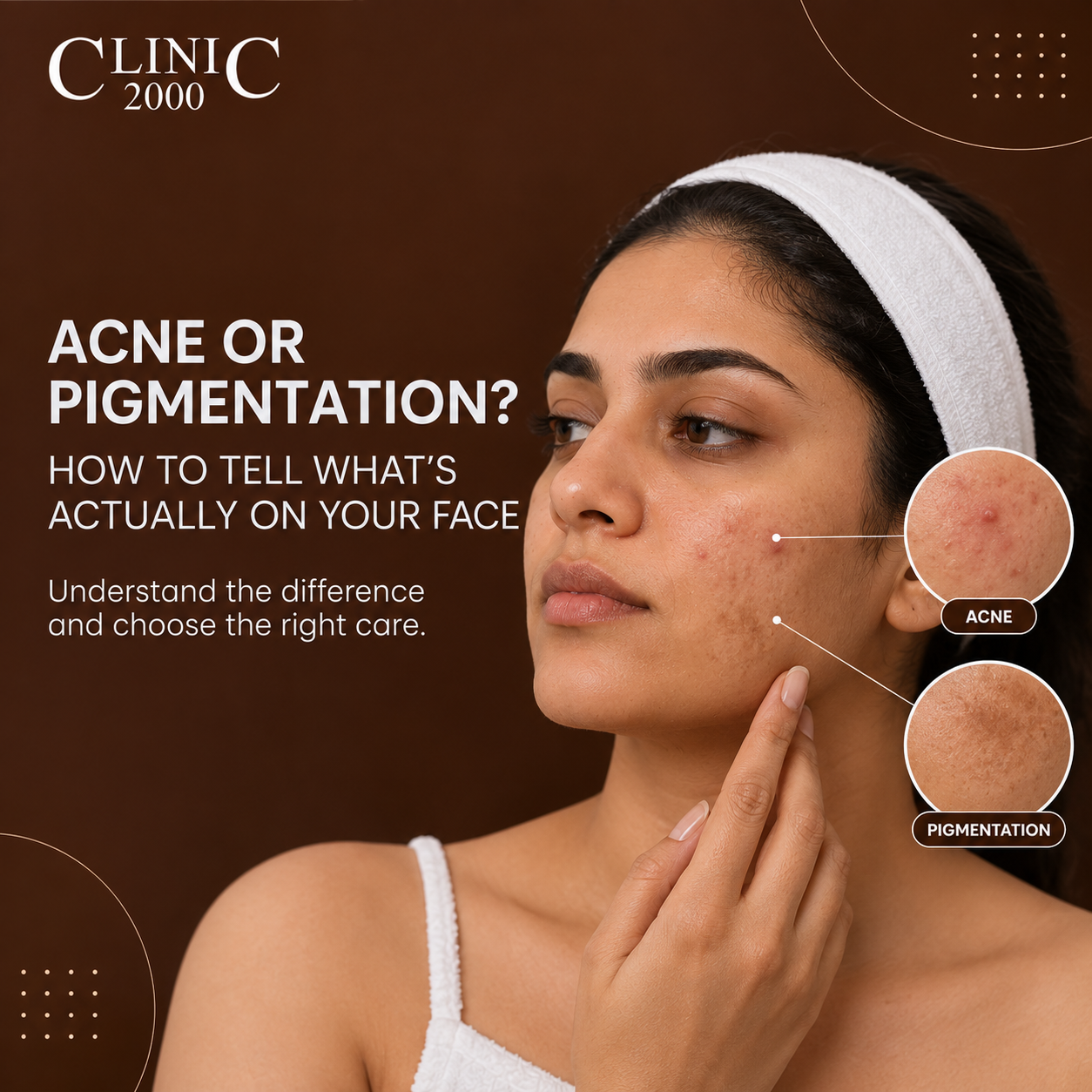
You are looking at dark marks on your cheeks. Are they acne? Are they pigmentation? Are they scars? The answer determines everything about what will help and what will make things worse, and yet it is one of the most confused distinctions in skincare.
The confusion is understandable, because these three conditions frequently coexist on the same face and often in the same spot. A pimple can leave a mark, that mark can darken into pigmentation, and if the original lesion was deep enough, a scar can sit underneath all of it.
This blog gives you a practical way to tell them apart, explains why the wrong treatment actively worsens the problem, and sets out the correct pathway for each.
What Acne Actually Is
Acne is an inflammatory condition of the pilosebaceous unit, the hair follicle and its attached oil gland. Four processes combine to produce it:
• Excess sebum production, largely androgen-driven
• Abnormal shedding of skin cells inside the follicle, which blocks it
• Proliferation of Cutibacterium acnes bacteria within the blocked follicle
• Inflammation as the immune system responds
Acne lesions are active, three-dimensional and change over days. They include blackheads, whiteheads, papules, pustules, nodules and cysts. The defining characteristic is that you can feel them.
What Pigmentation Actually Is
Pigmentation is a colour change with no structural component. Melanocytes produce excess melanin, which deposits in the epidermis or dermis, creating a flat area of darker skin.
Pigmentation is completely flat. Run a finger across it with your eyes closed and you will feel nothing. It does not fluctuate over days, and it does not become tender.
Pigmentation has many causes: sun exposure, hormonal drivers, inflammation, medication, friction. Our detailed comparison of melasma versus general hyperpigmentation explains the specific patterns within this category.
| Stop spending on creams that don’t work.Get a professional pigmentation assessment at Clinic 2000, Hyderabad.📞 Call: +91 91000 67718 | 💬 WhatsApp: +91 96762 31891 | 📍 Himayatnagar, Hyderabad | 🌐 clinic-2000.com |
The Overlap: Post-Inflammatory Hyperpigmentation
This is where almost all the confusion originates. Post-inflammatory hyperpigmentation, or PIH, is the flat dark mark left behind after an acne lesion resolves. It is not acne, because the inflammation is over. It is not a scar, because no tissue has been lost. It is pigmentation caused by acne.
PIH is significantly more common and more persistent in Indian and other skin of colour, because melanocytes in these skin types respond more vigorously to inflammation. This is why a spot that clears in three weeks on lighter skin may leave a mark lasting six months on Indian skin.
The critical implication: many patients who believe their acne is not clearing are actually looking at a face full of PIH from acne that resolved months ago. They are treating an active condition that no longer exists.
The 60-Second Self-Check
Three tests, in front of a mirror in good natural light.
The Touch Test
Close your eyes and run a fingertip lightly over the mark. Raised or bumpy means active acne. Indented means a scar. Completely flat means pigmentation or a mark.
The Timeline Test
How long has this specific mark been there? Active acne lesions resolve or evolve within one to three weeks. Anything unchanged for more than a month is pigmentation or scarring, not active acne.
The Tenderness Test
Press gently. Tenderness indicates active inflammation, meaning acne. Pigmentation and mature scars have no sensation.
Most faces will produce mixed results, and that is normal. The point is to identify what proportion of what you are seeing is active versus residual, because that ratio determines the treatment weighting.
Marks, Scars and Pigmentation Are Three Different Problems
• Acne marks (PIH) are flat, red or brown, and fade over months with the right approach
• Acne scars involve permanent loss or excess of collagen, creating indentation or elevation, and do not fade on their own
• Pigmentation unrelated to acne, such as melasma or sun damage, follows different patterns and has different triggers
The most expensive mistake patients make is undergoing resurfacing treatment for what they believe are scars when they actually have PIH, which would have faded with a fraction of the intervention. The reverse mistake, using brightening agents on true atrophic scars, produces no result at all because there is no excess pigment to address. Our guide to the five types of acne scars explains how to identify true scarring.
Why Treating the Wrong One Makes It Worse
This is not a neutral error. Mismatched treatment actively damages skin.
• Aggressive scrubs and physical exfoliation on active acne rupture lesions, spreading inflammation and creating more PIH than existed before
• Strong depigmenting agents on inflamed skin cause irritation, which triggers further melanin production, deepening the very pigmentation being treated
• Unsupervised high-strength peels on active inflammatory acne can cause chemical burns and long-lasting pigmentation on Indian skin
• Ignoring active acne while treating pigmentation means new lesions keep generating new marks faster than the old ones fade
The sequencing rule is simple: control active acne first, then address residual pigmentation, then treat true scarring last. Attempting all three simultaneously usually achieves none of them.
The Right Treatment Pathway for Each
For Active Acne
Treatment targets the four causative processes: sebum regulation, follicular shedding, bacterial load and inflammation. Depending on severity this may involve topical retinoids, topical or oral antibiotics for a limited period, hormonal management in women where androgens are driving it, and in-clinic procedures. Our acne treatment programme is built around identifying which of the four drivers dominates in each patient.
For Post-Inflammatory Hyperpigmentation
PIH responds well to consistent sun protection combined with topical brightening agents and superficial chemical peels formulated for Indian skin. It fades over months, not weeks. Daily broad-spectrum SPF is not optional here; UV exposure will re-darken PIH faster than any treatment can lighten it.
For True Pigmentation
Melasma and sun-induced pigmentation require a different approach, typically combining medical topicals, peel series and where appropriate laser, addressed through our pigmentation treatment protocol.
For Acne Scars
Structural scarring needs structural treatment: resurfacing lasers, microneedling with radiofrequency, subcision or fillers depending on scar type, delivered through our acne scar treatment services.
How Clinic 2000 Diagnoses This
We begin by mapping the face rather than treating it. In a first consultation we identify which areas are actively inflamed, which are PIH, which are true pigmentation and which are structurally scarred, because most patients present with all four in different zones.
That map determines sequence. Active acne gets controlled first, because treating marks while new lesions form is a treadmill. PIH is then addressed with a peel series and topical regimen. True scarring is treated last, once the skin is calm, because resurfacing inflamed skin risks worsening pigmentation.
Every plan is assessed by Dr. Ravindranath Reddy and delivered through our skin treatment services, using only FDA and CE approved technology calibrated for Indian skin types.
Conclusion
Acne, marks, pigmentation and scars look similar in a bathroom mirror and behave completely differently under treatment. The touch test alone resolves most of the confusion in ten seconds.
If your skin has not responded to months of products, it is worth asking whether you have been treating the right problem. Book a consultation with our team at Clinic 2000, Hyderabad for a proper assessment of what is actually on your skin.
| Clear, even skin is possible with the right clinical approach.Book your pigmentation consultation at Clinic 2000, Himayatnagar, Hyderabad.📞 Call: +91 91000 67718 | 💬 WhatsApp: +91 96762 31891 | 📍 Himayatnagar, Hyderabad | 🌐 clinic-2000.com |
Frequently Asked Questions
Q: What is the difference between acne and pigmentation?
Acne is an active inflammatory condition of the oil gland and follicle that you can feel as a raised or tender lesion. Pigmentation is a flat colour change with no texture. If you can feel it, it is acne or a scar. If you cannot, it is pigmentation.
Q: Are dark spots after pimples acne or pigmentation?
They are pigmentation, specifically post-inflammatory hyperpigmentation. The acne has already resolved; what remains is excess melanin produced in response to the inflammation. It needs pigmentation treatment, not acne treatment.
Q: How long do post-acne marks take to fade?
On Indian skin, typically three to twelve months without treatment, depending on depth. With consistent sun protection, appropriate topicals and a superficial peel series, that timeline shortens considerably. Without daily SPF, they may not fade at all.
Q: Can I treat acne and pigmentation at the same time?
Partially, but the sequencing matters. Active acne should be brought under control first, because ongoing inflammation continuously generates new pigmentation. Some agents address both, but aggressive pigmentation treatment on inflamed skin usually worsens the pigmentation.
Q: Will acne marks turn into permanent scars?
Flat marks will not, as no tissue has been lost. Scars form during the original inflammation, not afterwards. However, picking or squeezing lesions deepens inflammation and substantially raises scarring risk, which is why leaving them alone matters.