


Two patients start the same programme. Six weeks later, one has lost four kilos and looks almost unchanged. The other has lost half a kilo and has dropped two full dress sizes.
Both outcomes are common. Both are entirely explainable. And both demonstrate why the bathroom scale is one of the least useful tools for tracking body change.
This blog explains what the scale actually measures, what inch loss actually measures, why the two move independently, and what medically supervised inch loss treatment genuinely involves as opposed to what the wellness industry sells.
What the Weighing Scale Actually Measures
A scale measures the total gravitational load of everything in your body. That number is the sum of:
• Fat mass
• Muscle mass
• Bone mass
• Water, both intracellular and extracellular
• Glycogen stores, each gram of which binds roughly three grams of water
• Undigested food and waste
Only one of those six is the thing you want to reduce. The others fluctuate constantly. A single high-carbohydrate meal can add one to two kilos of glycogen-bound water within a day. Menstrual cycle phase can shift weight by two kilos. Sodium load, hydration and even time of day all move the number.
This is why daily weighing produces anxiety rather than information.
What Inch Loss Actually Measures
Circumference measurements track volume, not mass. Fat tissue is roughly 18 percent less dense than muscle tissue, which means a kilogram of fat occupies noticeably more space than a kilogram of muscle.
The practical consequence: you can replace two kilos of fat with two kilos of muscle, see zero change on the scale, and lose several centimetres from your waist. Your body has fundamentally changed. The scale has recorded nothing.
This is body recomposition, and it is the outcome most patients actually want when they say they want to lose weight.
| Stubborn inches that won’t budge? There’s a clinical solution.Book your inch loss consultation at Clinic 2000, Hyderabad.📞 Call: +91 91000 67718 | 💬 WhatsApp: +91 96762 31891 | 📍 Himayatnagar, Hyderabad | 🌐 clinic-2000.com |
Why Weight and Inches Move Independently
Weight Down, Inches Unchanged
Usually water and glycogen depletion in the first two weeks of any diet, often mistaken for rapid fat loss. It reverses the moment normal eating resumes, which is a large part of why crash diets appear to fail so suddenly. Muscle loss from excessive restriction also drops weight without improving shape.
Inches Down, Weight Unchanged
The recomposition window. Common in patients new to resistance training, patients returning after a long break, and patients whose protein intake has increased substantially. Muscle is being built while fat is being lost, in roughly equal mass.
Both Down
The most sustainable pattern, typically produced by a moderate deficit with adequate protein and resistance training. Slower on the scale than a crash diet, but the loss is fat rather than lean tissue.
Neither Moving
Often a plateau caused by metabolic adaptation, underestimated calorie intake, or a hormonal or thyroid factor. This is the point at which most people give up, and the point at which medical evaluation is most valuable. Our guide on why you might not be losing weight despite dieting covers this scenario in full.
Why Most Commercial Inch Loss Promises Fail
The inch loss category is full of claims that do not survive scrutiny. It is worth naming them plainly.
• Body wraps and sauna belts produce measurable circumference reduction that is entirely dehydration, and it reverses within hours of drinking water
• Vibration platforms do not meaningfully mobilise fat
• Standalone cavitation or radiofrequency sessions without dietary and metabolic change produce marginal, temporary results
• “Spot reduction” packages targeting only the abdomen contradict basic physiology, as fat mobilisation is systemic
What these approaches share is that they treat inch loss as a surface procedure rather than a metabolic outcome. Genuine, lasting circumference reduction requires the underlying fat to be mobilised and oxidised, and no external device does that on its own.
What Medically Supervised Inch Loss Looks Like
A clinically grounded programme addresses body composition, not just body weight. That means:
• Baseline body composition analysis measuring fat mass, lean mass, visceral fat and total body water separately
• Metabolic and hormonal screening, including thyroid function, insulin resistance markers and, where relevant, androgen levels
• A protein-adequate nutrition plan designed to preserve lean mass during fat loss
• Resistance training guidance, because muscle preservation is what keeps circumference dropping while metabolic rate holds
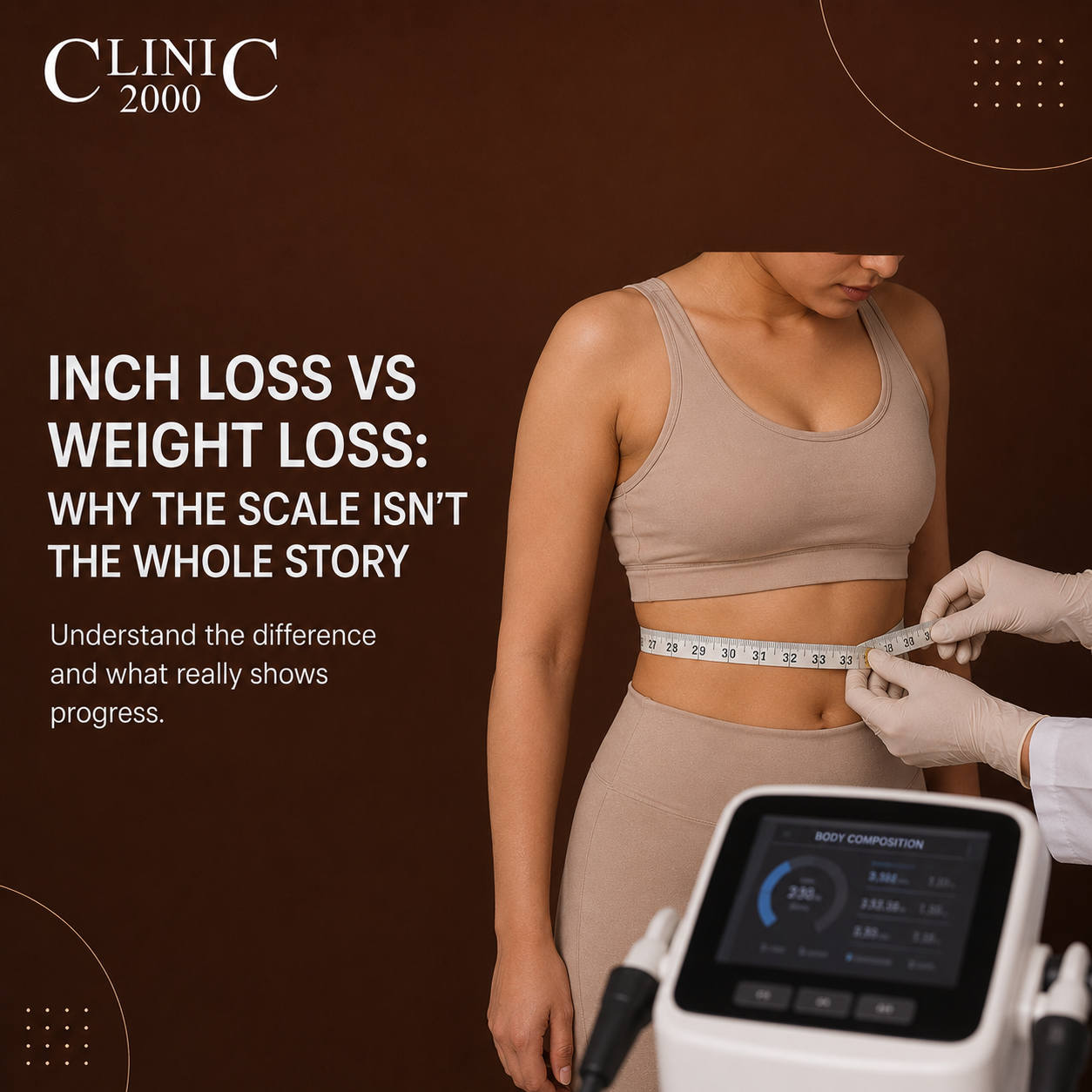
• Circumference tracking at fixed anatomical landmarks, measured by the same person each time
• Supportive in-clinic procedures where appropriate, used as an adjunct rather than the entire plan
The order matters. Devices layered on top of an unaddressed metabolic problem produce disappointing results, which is why we assess before we treat.
The Measurements Worth Tracking
Replace daily weighing with these, taken every two weeks at the same time of day:
• Waist circumference at the narrowest point, the single most clinically meaningful measurement
• Hip circumference at the widest point
• Waist-to-height ratio, which should ideally sit below 0.5
• Mid-thigh and mid-upper arm, useful for tracking lean mass changes
• Body composition analysis every four to six weeks
Waist circumference deserves particular attention because it correlates with visceral fat, the metabolically active fat surrounding the organs. That fat carries genuine health risk independent of total body weight, as we explain in our guide to visceral fat and its health consequences.
Realistic Timelines
Honest expectations prevent abandonment:
• Weeks 1 to 2: water and glycogen shifts dominate; treat scale movement as noise
• Weeks 3 to 6: first genuine circumference changes, typically 2 to 5 cm at the waist
• Weeks 6 to 12: visible shape change, clothing fit changes, body composition shift becomes measurable
• Months 3 to 6: substantial recomposition in patients who stay consistent
Anyone promising you two dress sizes in three weeks is either dehydrating you or lying to you.
How Clinic 2000 Approaches Inch Loss
We do not begin any inch loss programme without body composition analysis and a metabolic screen. Too many patients arrive after months of unsuccessful effort with an undiagnosed thyroid condition, insulin resistance or PCOS that made their previous attempts almost impossible to succeed at.
Once the metabolic picture is clear, we build a plan around preserving lean mass while mobilising fat, tracked through circumference and composition rather than scale weight alone. Our broader weight loss and obesity treatment services sit within South India’s first dedicated bariatric and obesity centre, led by Dr. Ravindranath Reddy across 28 years and more than 15,000 patients.
Where fat is reduced substantially and skin laxity becomes the limiting factor, we discuss non-surgical tightening options as a finishing step rather than a starting point.
Conclusion
The scale measures gravity. Your mirror, your clothes and your tape measure record what you actually care about. When they disagree, the scale is usually the one that is wrong.
If you have been losing weight without changing shape, or changing shape without losing weight, both are meaningful and both are explainable. Book a body composition assessment with our team at Clinic 2000, Hyderabad and find out what your body is actually doing.
| Reshape your body without surgery – measurable results per session.Book your inch loss consultation at Clinic 2000, Himayatnagar, Hyderabad.📞 Call: +91 91000 67718 | 💬 WhatsApp: +91 96762 31891 | 📍 Himayatnagar, Hyderabad | 🌐 clinic-2000.com |
Frequently Asked Questions
Q: Can I lose inches without losing weight?
Yes, and it is common. If you are simultaneously building muscle and losing fat in similar amounts, your weight stays flat while your circumference drops, because fat occupies more volume than muscle at the same mass. This is body recomposition and it is a good outcome.
Q: Which is more important, inch loss or weight loss?
Circumference, particularly waist measurement, is more clinically meaningful than scale weight. Waist size correlates with visceral fat and metabolic risk in a way total body weight does not.
Q: Do body wraps and sauna belts really reduce inches?
They produce a temporary circumference reduction through fluid loss, which reverses within hours of rehydrating. They do not reduce fat.
Q: How often should I measure myself?
Every two weeks, at the same time of day, in the same conditions, measured by the same person. More frequent measurement captures normal fluctuation rather than genuine change.
Q: Why has my weight stopped dropping even though I am still dieting?
Commonly metabolic adaptation, gradually increased calorie intake, or an undiagnosed thyroid or hormonal issue. A plateau lasting more than three to four weeks despite consistent effort is worth investigating medically rather than responding to with further restriction.