


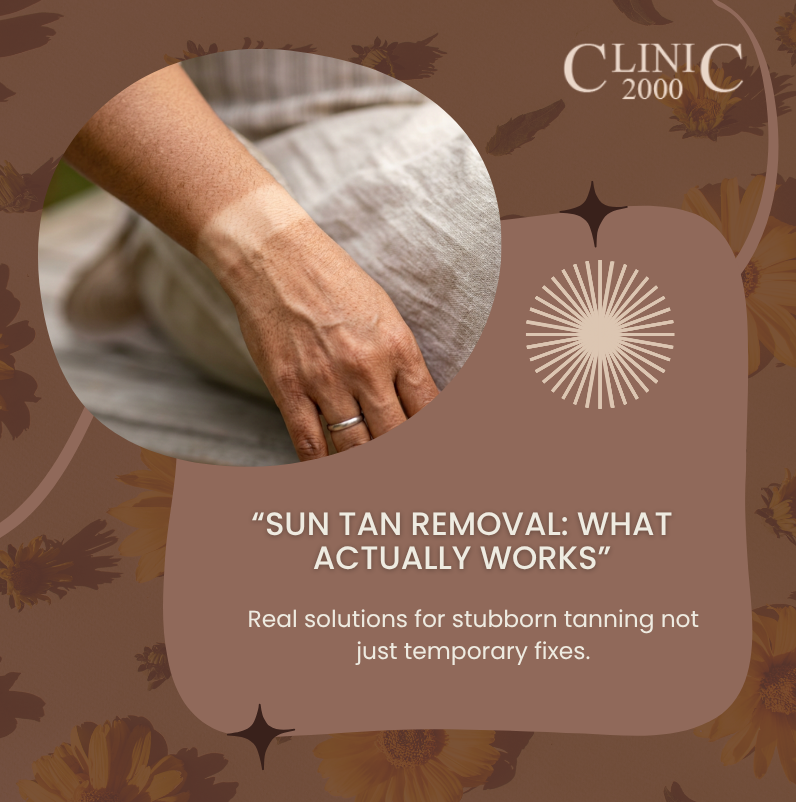
Hyderabad’s sun is intense and for most of the year, daily UV exposure is unavoidable. Whether it is from commuting, outdoor activities, or simply spending time near windows, the result is often the same: a tan that deepens over time, uneven skin tone, and patches of discoloration that no amount of scrubbing seems to fix.
The internet is full of home remedies for tan removal: lemon juice, tomato pulp, curd, besan, and countless other kitchen ingredients. Some of these may gently exfoliate or temporarily brighten the skin. But genuine, significant tan removal, especially for deep or accumulated UV damage requires clinical intervention.
In this blog, we explain what a tan actually is, why some tans are more stubborn than others, what home remedies can and cannot do, and which dermatological treatments effectively remove tan and restore your skin’s natural tone.
What Is a Tan and Why Does It Happen?
A tan is the skin’s protective response to UV radiation. When UV rays penetrate the skin, they trigger melanocytes (the pigment-producing cells) to produce more melanin, the dark pigment that gives skin its colour. This increased melanin acts as a natural shield, absorbing UV radiation to prevent deeper cellular damage. The visible darkening that we call a tan is melanin being distributed to the skin’s surface.
The tan appears gradually and builds over repeated UV exposures. Over time, without intervention and with continued sun exposure, melanin production can become irregular creating patches of hyperpigmentation, uneven tone, and accumulated sun damage that goes far deeper than a simple surface darkening.
Why Some Tans Are Harder to Remove Than Others
Depth of Pigmentation
A light surface tan involves melanin primarily in the outer epidermal layers. With the right treatment, this can be removed relatively quickly. But repeated, prolonged UV exposure drives melanin into the deeper dermis creating a tan that is significantly harder to treat and that topical products cannot reach.
Duration of Exposure
A recent tan from a single holiday is far easier to treat than years of accumulated sun exposure. The longer UV damage has been building, the more structural it becomes and the more clinical the approach needs to be.
Skin Photosensitivity
People with medium to dark skin tones very common across South India tend to produce melanin more readily in response to UV exposure. This means their tans are often deeper, more widespread, and more resistant to superficial treatments.
What Home Remedies Can and Cannot Do
Mild exfoliating ingredients in home remedies, lemon (citric acid), tomato (lycopene), curd (lactic acid) can gently remove dead surface cells, which may give a slightly brighter appearance temporarily. However:
• They cannot penetrate the dermis where deep tan pigmentation resides
• Lemon juice applied to sun-exposed skin can cause phytophotodermatitis, a severe skin reaction that darkens skin further
• Most kitchen remedies do not have sufficient active ingredient concentration to produce meaningful, lasting results
• They offer no protection from future UV damage, so the tan returns quickly
This does not mean you should never use gentle natural ingredients on your skin but for real tan removal, they are not the answer.
Clinical Treatments That Remove Tan Effectively
1. Chemical Peels
Chemical peels are the most commonly used clinical treatment for tan removal. They work by applying an acid solution that dissolves the bonds between dead, pigmented surface cells, exfoliating them to reveal the fresher, lighter skin underneath. Repeated peeling sessions progressively lighten and even out skin tone.
At Clinic 2000, the Super Peel and C2K Peel are specifically formulated for Indian skin tones and are highly effective for surface and moderate-depth tan removal. The appropriate peel type and strength is chosen based on your skin type, depth of pigmentation, and desired outcome.
2. HydraFacial
The HydraFacial is an excellent treatment for mild to moderate tanning and uneven skin tone. Its patented Vortex-Fusion technology simultaneously exfoliates, extracts, and infuses skin with brightening serums, delivering immediate improvement in tone, radiance, and texture. It is suitable for all skin types with zero downtime and no recovery period.
3. Microdermabrasion
Microdermabrasion uses fine crystals or a diamond tip to physically exfoliate the outer layer of skin, removing pigmented surface cells and stimulating the growth of fresh, even-toned new skin. It is particularly effective for surface tan and overall dullness, and complements deeper treatments well.
4. Laser Treatment
For deep, accumulated, or treatment-resistant pigmentation, the E+ Laser at Clinic 2000 targets melanin deposits at deeper skin levels with precision. Laser treatment produces significant lightning and is the most powerful clinical option for stubborn or long-standing tan damage. Results are typically visible within 2 to 3 sessions.
5. Skin Polishing
Skin polishing at Clinic 2000 is a procedure that combines exfoliation with nourishing active ingredients to deeply cleanse, brighten, and even out skin tone. It is an excellent adjunct to chemical peels or laser treatment for patients seeking comprehensive skin renewal.
The Role of SPF – The Most Important Step
No tan removal treatment will produce lasting results without sun protection. Every time your skin is exposed to UV without adequate SPF, melanin production is triggered again, and the tan returns often more stubborn than before. SPF is not optional, it is the foundation of any effective skin brightening programme.
Our dermatologist will recommend an appropriate SPF 30 or 50 broad-spectrum sunscreen for daily use, along with guidance on application and reapplication throughout the day, particularly in Hyderabad’s high UV environment.
How Clinic 2000 Approaches Tan Removal
At Clinic 2000, we begin with a skin assessment that determines the depth of pigmentation, skin type, and any co-existing concerns such as melasma or post-inflammatory hyperpigmentation. Based on this, we design a combination treatment plan which may include chemical peels, HydraFacial, microdermabrasion, and laser, alongside a home skincare routine with SPF and brightening agents.
Our goal is not just to remove the current tan but to improve the overall quality of your skin and give you the tools to protect it going forward.
Conclusion
Sun tan removal is absolutely achievable but the results you want require more than kitchen remedies or store-bought fairness creams. With the right clinical approach, even deep, long-standing UV pigmentation can be significantly reduced, leaving skin noticeably lighter, more even, and healthier overall.
At Clinic 2000, our dermatologists have been treating UV pigmentation and skin concerns in Hyderabad for over 28 years. If your skin’s tone has been affected by sun damage and you are ready for real results, book a consultation today.
Frequently Asked Questions
Q: How many sessions are needed to remove a tan? It depends on the depth and duration of the tan. Surface tanning can improve significantly within 2 to 3 peel sessions. Deep or long-standing UV damage may require 6 or more sessions combined with laser treatment.
Q: Is tan removal safe for dark skin tones? Yes, when performed with the right treatments at the right parameters. At Clinic 2000, our peels and laser are specifically calibrated for Indian and South Asian skin tones, ensuring safety and effectiveness.
Q: Can I get tan removal treatments done and then go back in the sun? You can, but you must apply SPF 30 or higher every day. Without SPF, the tan will return and treated skin may be temporarily more sensitive to UV. We recommend starting tan removal in winter or monsoon when UV intensity is lower.
Q: Is HydraFacial enough to remove a tan? HydraFacial is very effective for mild to moderate tanning. For deeper or more stubborn pigmentation, a combination approach including peels or laser is recommended.
Q: How soon will I see results? Most patients notice visible brightening after the first session. Full results build progressively over 4 to 6 sessions.