


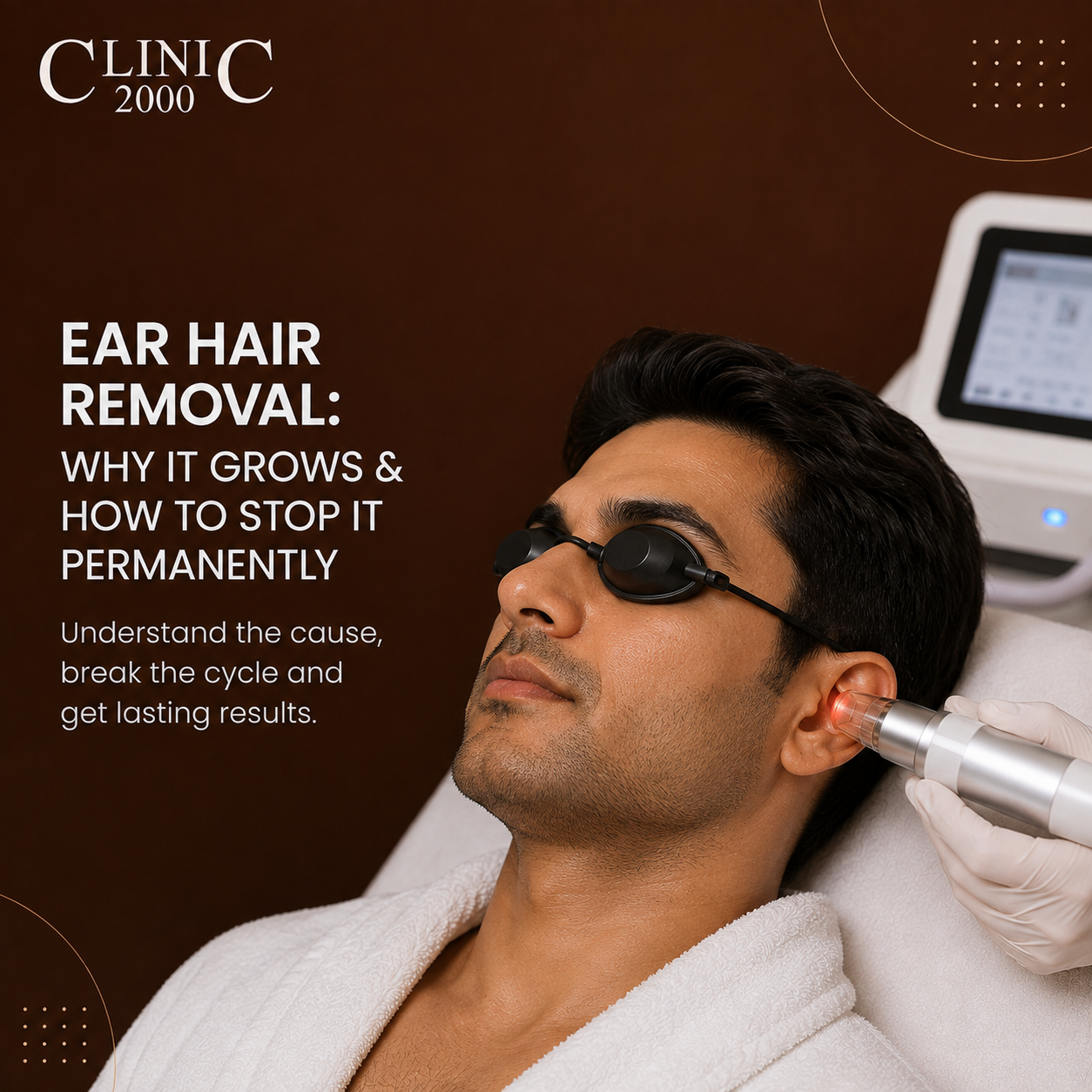
Nobody plans for ear hair. It arrives quietly, usually somewhere between the mid-thirties and mid-forties, and by the time you notice it in a photograph or a car mirror, it has already been there a while.
Ear hair is one of the least discussed and most persistently searched grooming concerns, particularly among men. The reason it feels so difficult to manage is simple: the tools most people reach for, tweezers and trimmers, are the two worst options for the area.
This blog explains why ear hair develops, why it seems to return faster each time you deal with it, what the actual health considerations are, and how permanent ear hair removal works at Clinic 2000 in Hyderabad.
Why Ear Hair Appears With Age
Everyone has hair on and around their ears from birth. It is fine, colourless vellus hair that is essentially invisible. What changes with age is not the presence of follicles but their behaviour.
Dihydrotestosterone, or DHT, is a potent derivative of testosterone. It has a paradoxical effect on human hair: it shrinks follicles on the scalp while enlarging follicles in the ears, nose, eyebrows and back. As cumulative lifetime DHT exposure increases, vellus follicles in these areas convert to terminal follicles, producing thick, dark, visible hair.
This is why ear hair and scalp thinning frequently appear in the same men at the same time. They are two expressions of the same hormonal process. If you are noticing both, our guidance on hair loss diagnosis and treatment explains the scalp side of that equation.
Women can develop ear hair too, most commonly after menopause when the oestrogen to androgen ratio shifts.
Where Ear Hair Actually Grows
Understanding the anatomy matters, because it determines what can and cannot be treated safely.
• Tragus and antitragus, the small cartilage projections at the ear opening
• Helix and antihelix, the outer and inner rim of the ear
• Lobule, the earlobe
• Outer canal entrance, the visible portion just inside the opening
• Deep ear canal, which is never treated cosmetically under any circumstances
Cosmetic removal addresses only externally visible hair. Hair deep inside the canal serves a genuine protective function and is left entirely alone.
Why Plucking and Trimming Keep Failing You
Plucking
Tweezing ear hair removes the shaft but leaves the follicle intact and inflamed. In an area with limited air circulation and frequent contact with earphones, phones and pillows, that inflamed follicle is prone to infection. Ear folliculitis is genuinely painful because the skin sits directly over cartilage with almost no cushioning tissue.
Trimming
Trimming is safe but produces a blunt cut end. Blunt-tipped hair catches light differently and often appears more noticeable within days. It also means repeating the process weekly, indefinitely.
Waxing and Threading
Both are difficult to perform accurately on curved cartilage, and both risk pulling on skin that is thin and tightly adherent. Home waxing near the ear canal carries a real risk of wax entering the canal, which is a problem requiring medical removal.
Depilatory Creams
Never appropriate for the ear. Chemical depilatories are not formulated for use near the ear canal or mucosal tissue, and accidental entry can cause chemical irritation of the canal lining.
Is Ear Hair a Health Concern or Purely Cosmetic?
Mostly cosmetic, with a few genuine considerations. Excessive external ear hair can trap moisture and sweat, contributing to irritation in humid climates like Hyderabad’s. Dense hair at the canal entrance can also make ear wax more likely to accumulate rather than migrate outward naturally.
What ear hair does not do is affect hearing, and there is no reliable evidence linking it to cardiovascular risk despite persistent internet claims to the contrary.
The stronger clinical point is what ear hair indicates. Rapid onset of coarse ear hair alongside other androgenic changes is worth mentioning to a doctor, particularly if it appears unusually early.
How Laser Ear Hair Removal Works
The principle is the same as anywhere else on the body. Concentrated light energy is absorbed by melanin in the hair shaft, converted to heat, and delivered to the follicle root, impairing its capacity to regrow hair. Our full explanation of the mechanism and its limits is covered in our guide on whether laser hair removal is genuinely permanent.
What makes the ear different is precision. The treatment area is small, curved, and adjacent to the canal. Three safety requirements are non-negotiable:
• A small-spot handpiece that can follow the ear’s contours accurately
• Physical shielding of the ear canal throughout the procedure
• An operator experienced in facial and periauricular treatment, not a general body technician
Treatment is strictly limited to externally visible hair. No energy is directed into the canal.
Sessions, Timeline and What to Expect
Ear hair typically requires 6 to 8 sessions spaced 4 to 6 weeks apart, similar to other facial areas. Because ear hair is usually coarse and dark by the time patients seek treatment, it absorbs laser energy efficiently, which generally means a good response rate.
The session itself is short, often under five minutes for both ears. Most patients report a brief warm snap per pulse. Mild redness for a few hours afterwards is normal.
Aftercare is straightforward: avoid direct sun on the ears for 48 hours, skip swimming pools for two days, and keep earphones out for the first 24 hours to prevent friction on treated skin.
For patients treating multiple areas at once, our full laser hair removal service allows the ears to be combined with other facial zones in a single appointment, which is more efficient than booking separately. Many male patients combine ear treatment with nose, neckline or upper lip and facial hair work in the same session.
What Ear Hair Removal Costs in Hyderabad
The ears are among the smallest treatment areas, so per-session cost is at the lower end of the laser hair removal range. Where patients get better value is in combination pricing, since treating ears alongside another facial area in one visit reduces the effective cost of both. Our cost guide sets out how area size and session count determine total investment.
Be cautious of very low quoted prices for ear treatment specifically. This area demands operator precision, and clinics offering it at throwaway rates are often using body handpieces that are too large to treat the ear contour safely.
How Clinic 2000 Approaches Ear Hair Removal
We treat the ear as a facial area, not a body area. That means the same assessment protocol we apply to the upper lip and chin: skin type evaluation, patch testing where indicated, small-spot handpiece, canal shielding, and treatment performed by an operator trained specifically in facial laser work.
We also ask about the wider picture. If a patient in his early thirties has developed coarse ear hair alongside noticeable scalp thinning, we discuss both, because addressing one while ignoring the other rarely satisfies anyone. Every treatment plan is supervised by Dr. Ravindranath Reddy and his clinical team.
Conclusion
Ear hair is a normal consequence of hormonal ageing, not a hygiene failure. But that does not mean the only options are weekly trimming or painful tweezing.
Laser reduction offers a way out of the maintenance cycle, provided it is done with the right handpiece, the right shielding and the right operator. If ear hair has become a permanent item on your grooming routine, speak to our team at Clinic 2000, Hyderabad about what a treatment series would involve.
Frequently Asked Questions
Q: Is laser hair removal safe near the ear canal?
Yes, when performed correctly. Treatment is limited strictly to externally visible hair with the canal physically shielded throughout. No laser energy is directed into the canal itself, and hair deep inside the ear is never treated.
Q: How many sessions does permanent ear hair removal need?
Most patients need 6 to 8 sessions spaced 4 to 6 weeks apart, followed by occasional maintenance. Coarse dark ear hair generally responds well because it contains abundant melanin for the laser to target.
Q: Why does my ear hair grow back thicker after I pluck it?
It does not actually grow back thicker. Plucking removes the tapered natural tip, so regrowth emerges blunt-ended and feels coarser. What genuinely thickens ear hair over time is DHT exposure, not the removal method.
Q: Can women get ear hair removal too?
Yes. Ear hair is less common in women but does occur, most often after menopause when hormonal ratios change. The treatment protocol is identical.
Q: Should I trim my ear hair before a laser session?
Yes, trimming is the correct preparation. You should stop plucking and waxing at least four weeks before your first session, since the laser needs an intact root to target, but trimming or shaving is fine right up to the appointment.