


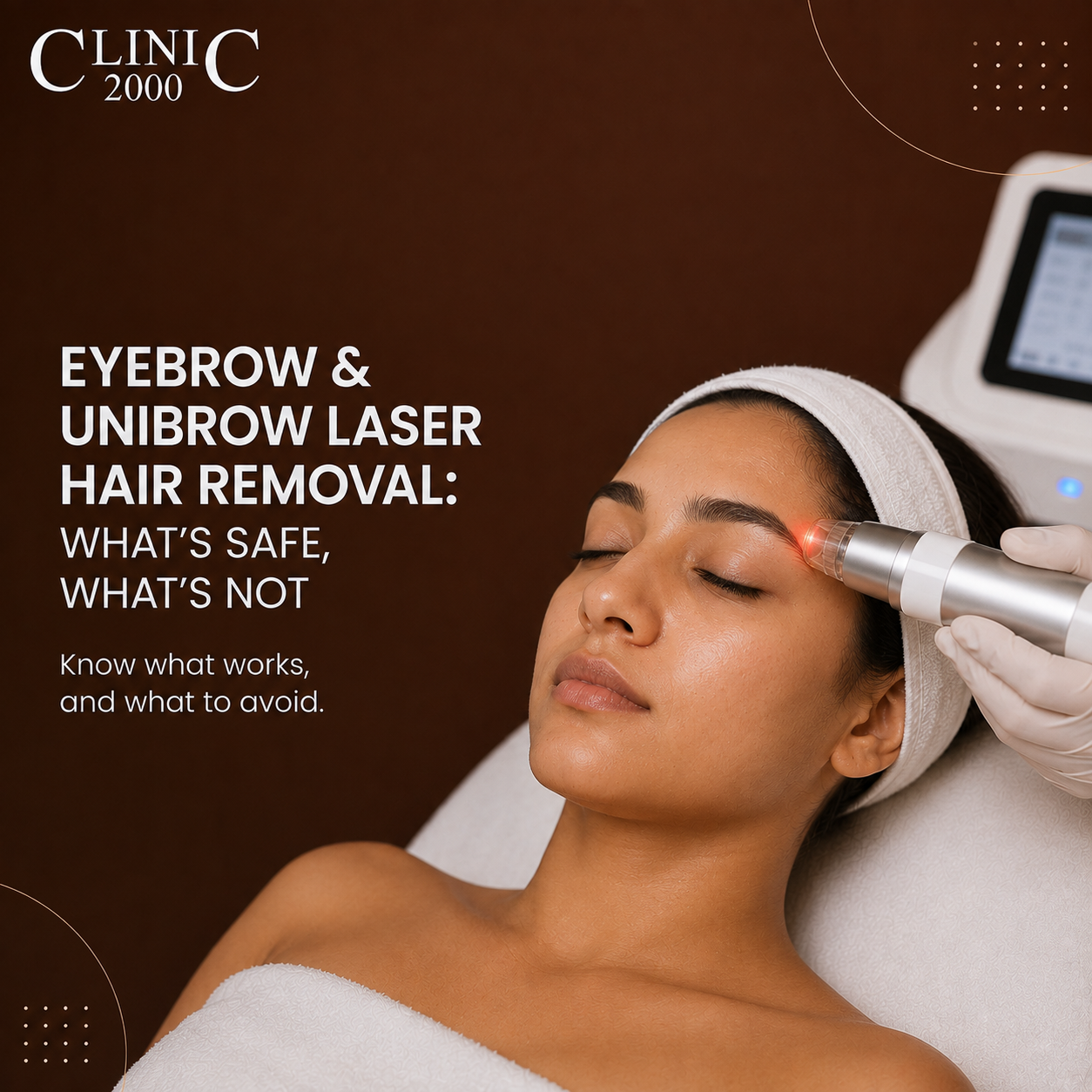
The space between the eyebrows is one of the most threaded patches of skin on the human face. For anyone with naturally dense brow hair, it is a fortnightly appointment that never ends, and one that leaves a stubbly shadow within a week.
Permanent removal sounds like an obvious solution. It can be, but the eyebrow region demands more caution than any other area on the body, and there are parts of it that no reputable clinic will ever treat.
This blog covers exactly what can be safely treated around the brow, what cannot and why, how the procedure works, and how to evaluate whether a clinic offering eyebrow laser hair removal is doing it responsibly.
Why Unibrow and Stray Brow Hair Happens
Brow density is largely genetic. Populations with naturally darker, coarser hair, including South Asian and Middle Eastern groups, tend to have more terminal follicles across the glabella, the flat area between the brows.
Beyond genetics, three factors influence brow hair density:
• Androgen levels, which increase terminal hair conversion across the face
• Age, with brow hair often becoming coarser and longer in men after forty
• Repeated threading, which does not increase density but can cause irregular regrowth patterns and stray hairs outside the natural brow line
Excessive brow and glabellar hair in women, particularly when it appears alongside upper lip and chin hair, can be part of a wider androgenic picture worth evaluating medically. Our article on PCOS and hormonal weight gain explains that mechanism in detail.
The Critical Safety Boundary: What Is Never Treated
This is the section that matters most, and the one many clinics gloss over.
The eye is exquisitely vulnerable to laser energy. The retina absorbs the same wavelengths used in hair removal, and the eyelid provides almost no protection against them. Because of this, there is a firm anatomical boundary in laser hair removal:
• Treated: the glabella between the brows, the area above the brow toward the forehead, and stray hairs on the temple side, all outside the bony orbital rim
• Never treated: anywhere inside the orbital rim, including the eyelid, the lash line, and the lower brow border that sits over the eye socket
Any clinic willing to laser inside the orbital rim, or unwilling to explain this boundary to you, should be avoided. Metal corneal eye shields are the standard of care for periocular work, and disposable adhesive eye pads are not an equivalent substitute for treatment this close to the eye.
Threading vs Waxing vs Laser for the Brow Area
Threading
Precise and inexpensive, and still the best option for shaping the brow line itself. The drawback is frequency, and on Indian skin the repeated inflammation between the brows commonly leaves a faint darkened patch over the years.
Waxing
Faster than threading but far less precise near the brow line, with a genuine risk of removing more than intended. Waxing also carries higher risk of lifting delicate skin, particularly in patients using retinoids or acne medication.
Laser
The only method offering long-term reduction, but restricted to areas outside the orbital rim. Laser is excellent for the glabella and unibrow. It is not a brow shaping tool, and it should never be used to define the lower brow border.
The One Decision You Cannot Undo
Brow trends move fast. Thin, heavily shaped brows dominated one decade; full natural brows dominated the next. Threading is forgiving because hair regrows. Laser is not.
For this reason we apply a deliberately conservative rule: we treat the clearly excess hair between and above the brows, and we leave anything that contributes to brow shape alone. A patient who wants a narrower brow line today may want a fuller one in five years, and permanent reduction removes that option entirely.
This restraint is the difference between a clinic optimising for a single sale and a clinic optimising for a patient who will still be happy in a decade.
How the Procedure Works
The mechanism is the same as elsewhere on the body: melanin in the hair shaft absorbs laser light, converts it to heat, and that heat impairs the follicle’s growth structures. Our full technical breakdown appears in our guide to how permanent laser hair removal really is.
For the brow region specifically:
• Corneal eye shields are placed before any energy is delivered
• The treatment boundary is marked out and confirmed with the patient before starting
• A small-spot handpiece is used for precision around the brow contour
• Sessions are brief, typically two to three minutes for the glabella
Because facial hair cycles faster than body hair, sessions are spaced 4 to 6 weeks apart. Most patients need 6 to 8 sessions for the glabella, with maintenance every 8 to 12 months.
Is It Safe for Indian Skin Tones?
Yes, with the correct device. Higher epidermal melanin in Fitzpatrick IV and V skin means the wrong wavelength can target skin pigment rather than hair pigment, risking burns or post-treatment pigmentation.
Longer-wavelength systems with integrated contact cooling are appropriate for Indian skin. At Clinic 2000, our laser hair removal programme uses FDA and CE approved E+ technology, with settings calibrated per patient after skin type assessment and patch testing where indicated.
The glabella is also a high-sebum area prone to breakouts, so we assess for active acne before treatment. Treating over inflamed lesions increases pigmentation risk, and our guidance on telling acne apart from pigmentation is relevant for anyone unsure what they are seeing between their brows.
What It Costs and What Drives the Price
The glabella is a very small treatment area, making it one of the lowest per-session costs in laser hair removal. Most patients treating this area combine it with the upper lip or chin, which is more economical than booking a single tiny zone.
Pricing depends on the device, the operator’s qualification, and package structure. Our laser hair removal cost guide explains how these factors combine. For periocular work in particular, operator experience should weigh more heavily in your decision than price.
How Clinic 2000 Approaches Eyebrow and Unibrow Treatment
Our protocol for this area is deliberately more conservative than our body protocols. We map the treatment boundary with the patient before the first session, we treat outside the orbital rim only, and we use corneal shields on every single case without exception.
We also decline requests we consider inadvisable. If a patient asks for permanent reduction along the lower brow border to create a shape, we explain why we will not do it. Every periocular plan is reviewed by Dr. Ravindranath Reddy, whose 28 years of clinical practice inform where the line between cosmetic benefit and unnecessary risk sits.
Conclusion
Permanent unibrow removal is one of the most satisfying small treatments in aesthetic medicine. It eliminates a fortnightly chore and removes the shadow that threading leaves behind.
But the eyebrow region is the one area where the right answer is sometimes no. A clinic that treats everything you ask for near your eyes is not being accommodating; it is being careless. If you want a properly assessed plan for the area between your brows, book a consultation with our team at Clinic 2000, Hyderabad.
Frequently Asked Questions
Q: Is laser hair removal safe near the eyes?
It is safe outside the bony orbital rim with corneal eye shields in place. It is never safe inside the orbital rim, on the eyelid, or along the lash line, because the retina absorbs the same wavelengths used to target hair. Any clinic willing to treat inside that boundary should be avoided.
Q: Can laser reshape my eyebrows permanently?
We do not recommend it. Brow trends change and laser reduction cannot be reversed. We treat clearly excess hair between and above the brows, and leave the brow shape itself to threading, which is fully reversible.
Q: How many sessions does unibrow removal take?
Most patients need 6 to 8 sessions spaced 4 to 6 weeks apart for the glabella, followed by maintenance every 8 to 12 months. Coarse dark hair typically responds faster than fine light hair.
Q: Will it leave a mark between my brows?
Correctly performed treatment should not. Brief redness for a few hours is normal. Risk of pigmentation rises with incorrect settings, recent sun exposure, or treating over active acne, all of which we screen for beforehand.
Q: Can men get unibrow laser treatment?
Yes, and it is a common request. The protocol, session count and safety boundaries are identical regardless of gender.